Saturday, April 13, 2013

Somebody Always Pays (or "Failure to Appreciate Reality Doesn't Make It Go Away")

Originally I had anticipated stopping at Gettysburg on my way from Pittsburgh to DC, but as you have no doubt observed, the Driveabout is a fluid thing with a lot of audibles and play action calls and probably some more football metaphors that escape me right now.  I never did get to Gettysburg.

My cousin's husband. Ken, strongly suggested that I not miss Fallingwater while I was in the Alleghenies, and people have rarely steered me wrong so I decided to start the day there, which is about an hour and a half south of Pittsburgh.

Surprisingly, I was running early for my scheduled tour (you have to sign up for tours in advance at Fallingwater) so I drove about fifteen minutes further south to see Kentuck Knob, which is another Frank Lloyd Wright house.  That is a beautiful drive on very winding and hilly roads through a whitewater rafting town called Ohiopyle (an odd name, don't you think?), and even though I didn't take/make the time to see the house, I'm glad I swung by.  If you are heavily into FLW, you should see both.  The owner of Kentuck Knob must have been quite a character, because in addition to some cool birdhouses in the front yard (the kind that look like dollhouses on a stick), there's a red English-style telephone booth sitting on the grass.  A nice fallback if your cellphone goes out, I guess.

Fallingwater was built as a weekend home for the the family that owned the Kaufmann's Department Store in Pittsburgh.  It sits, literally, over Bear Run at a spot where there are three small waterfalls, one of which is the central feature of the house.  The house was donated to the Western Pennsylvania Conservancy by Edgar Kaufmann, Jr., and has been run by the Conservancy for many years.  It definitely has the feel of being run by something called a Conservancy.  You are greeted at the gate by an older lady who, like the rest of the staff, manages to combine a sense of vague disdain and suspicion (that you will harm the house, or break a rule, or something) with a genuine expression of being glad you are here.  It's very Old Money, really, and I don't mean that in a bad way.  It simply is.  I was assigned to Group 5 and we waited a few minutes until the appointed time to be summoned to a spot in the Visitor Center where we were sent on a short walk to the house itself.

Group 5 included a family with three sons who looked to be in their late teens.  They were nice boys and their interests - or at least, their willingness to voice questions that several of us might have had - were funny. For instance, they asked why the toilets were so low (the answer - it was believed, in the 1930's, that such placement assisted in one's, um, use of the equipment).  When Ed, our tour guide, described the third floor as being the sole residence of Edgar, Jr., the boys lit up, impressed with the thought of having an entire floor (it is three rooms, including a bathroom with a low toilet) to oneself.

April 9, the day I joined Group 5, is significant at Fallingwater because it is the birthday of Edgar Jr. and the anniversary of Frank Lloyd Wright's death in 1959.  They didn't have a ceremony or anything, it was just something Ed the Tour Guide mentioned.

I won't go on and on about the architectural significance of Fallingwater, but it was really impressive.  Another member of Group 5, who apparently lives in the area, has visited at each season.  Here is what it looks like in mid-April:


You'll note the cantilevered decks going out over the waterfall.  (Cantilever is a very important word at Fallingwater.  For you non-technical people, it means something that is secured and counterbalanced at one end, and therefore does not require support on the other end.)  You may also observe that the decks appear to be pulling a little downward.  This is both accurate and not intended.  Wright was more an artist and less  an engineer, although he had great (and, it turns out, unjustified) confidence in his abilities.  He didn't specify enough structural steel to support the weight of the decks.  Mr. Kaufmann, being a man used to making his own decisions and understandably a bit nervous about the plan, consulted some of his engineer friends in Pittsburgh who advised that they definitely needed more steel if there were to be any hope of the building not collapsing.  Kaufmann directed the contractor (who, although experienced, had never built anything like this before) to add more steel against the express instructions of Wright.  Turns out it's a good thing Kaufmann did so - Wright was wrong (I had to say that - sorry) and the house would have fallen down without the additional steel.  In fact, they didn't put enough in, and the contractor didn't think to allow for some gravity settling, so the Conservancy had to do a massive renovation a few years ago.  Somebody always pays.

And then, with the theme of "You Can't Fool Mother Nature" firmly in my little head, I was off to Johnstown to see their Flood Museum.

On the way, I encountered the Kinsey Museum.
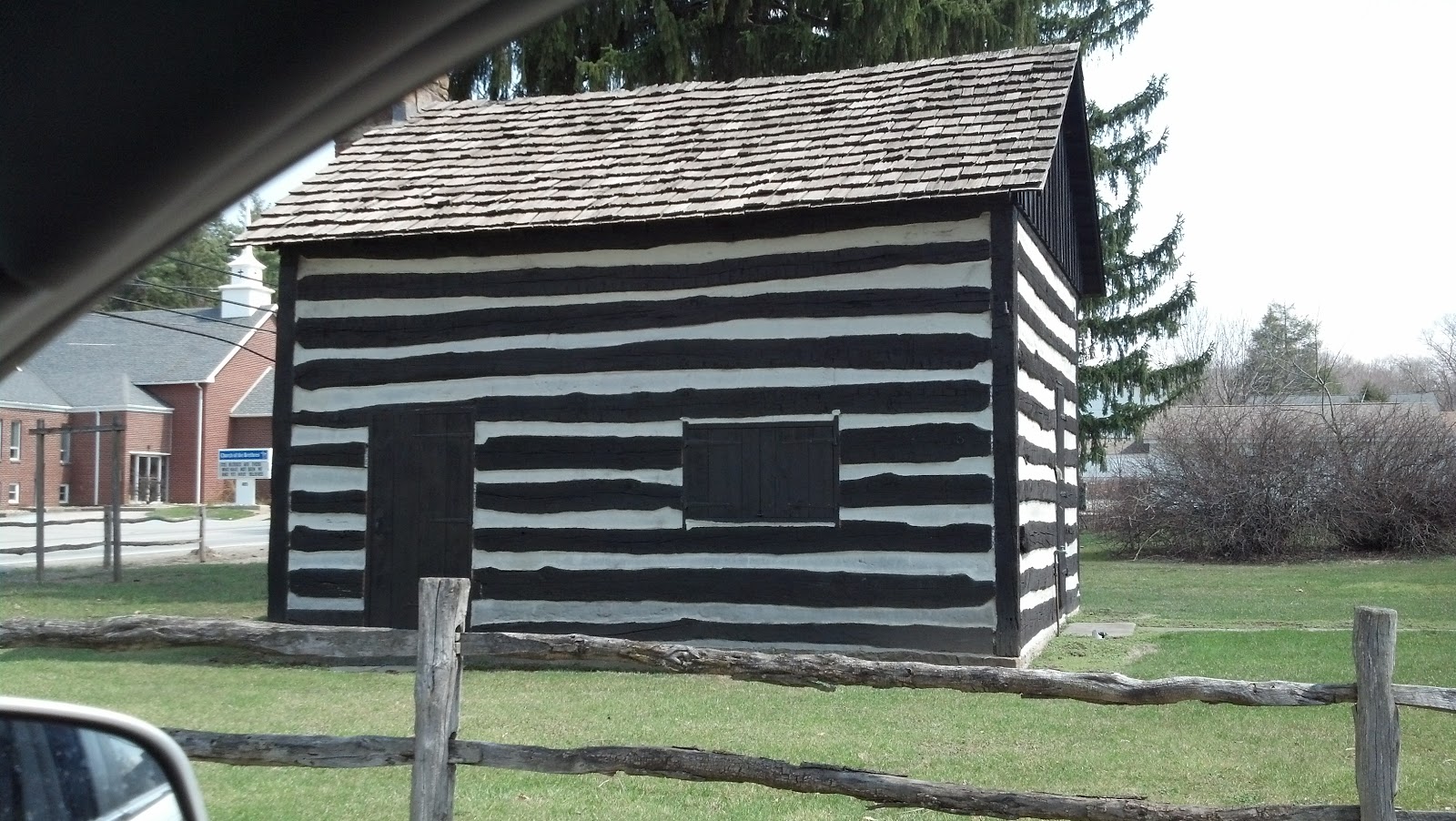

That's it.  It's on Highway 271 north of Ligonier (Pennsylvania, not Indiana) in what seemed like a town but I think it was just Suburban Ligonier.  It was neither open nor was it apparent how you'd actually get in, or even what it was a museum about, but there was a sign so I took a picture and continued north.

Johnstown seemed more like what I'd expected Youngstown would be like:  not exactly prosperous.  Okay, more than a little run down.  The only employer appeared to be the hospital.  But the people were extremely friendly and the town has been through a lot so it's hard not to want to give the place a break.

Situated in a valley, where the Little Conemaugh River comes down from the mountains, meeting the Stonycreek River to form the Conemaugh, Johnstown is not a stranger to flooding.  But in 1889, the culmination of decades of short-sighted decisionmaking came home to roost in a terrible way.

In the 1840's you may recall, back before the railroads, a number of states invested heavily in development of the canal system (including Indiana, whose near-bankruptcy due to the canal left a legacy of unwillingness to invest in infrastructure that continues, IMHO, to plague the state - but that's sort of off-topic).  Anyway, Pennsylvania decided it would be a good idea to build a reservoir, eventually known as Lake Conemaugh, by damming up the Little Conemaugh fourteen miles upstream from Johnstown.  This was to be used as a way to transport goods from east to west through the Alleghenies.  Like so many of the midwestern states that took a while to get into the canal business (again, including Indiana), by the time they finally finished building, they had been overtaken by technology.  The railroads came along and the canals went away - almost as quickly as 8-track tapes, and for similar reasons.  Lake Conemaugh instantly became something of a dead weight, and the state stopped maintaining the dam. In fact, they sold it to a series of private owners who not only avoided maintenance, but took a number of steps that made the dam even less safe.  And despite a small failure of the dam in the 1870's, and routine warnings from people who were most likely viewed as Boys Who Cried Wolf, such neglect continued under the ownership of the South Fork Hunting and Fishing Club in the 1880's.  The Club, an invitation-only club for 61 of Pittsburgh's most elite citizens, provided a beautiful getaway from the city's dirt and grime for people who made a lot of money off that dirt and grime.  People like Andrew Carnegie were members, if that gives you any idea of how elite elite was in the 1880's.

Meanwhile, down in the valley, Johnstown was a prosperous industrial city.  Seven thousand of the town's 30,000 residents worked for the Cambria Iron Company, living in company-owned housing, shopping at the company store, and being treated in the company hospital.  Their steel was used to build the Brooklyn Bridge.  An Academy-award winning film at the Flood Museum (which ironically is located in a renovated Carnegie Library) points out that there were 71 telephones in Johnstown in 1889.  There were over 120 bars, but all that shows is that they had their priorities straight back then.  And of course people in Johnstown were used to floods.  But no one could be ready for what happened on May 31, 1889.

It had been raining heavily for several days when, on the morning of the 31st, the maintenance foreman at the South Fork Hunting and Fishing Club observed that the dam was becoming compromised.  He sent a warning downstream, which was no small trick since the storms had knocked out telegraph lines.  They began efforts to shore up the dam, but it was too little, too late, and at 3:10 p.m. the dam burst.  It only took an hour for the twenty million gallons of water in Lake Conemaugh to travel the fourteen miles to Johnstown, and the water arrived in a wave of over three stories (37 feet) above normal river level.  It crashed through town until it reached a very tall hill, which had the effect of rolling the floodwaters back onto the city.  A stone bridge stopped the floodwater when fourteen miles worth of debris created a dam that was stronger than the man-made (and man-ignored) dam upstream.  The initial devastation occurred in just ten minutes - which fact was documented by a young boy who happened to check his pocket watch - but it was about to get even worse.

Just as survivors started to dig themselves out - and a number of folks were trapped in the makeshift dam - the oil and other industrial combustibles in the debris caught fire and burned for three days.  2,209 souls were lost in the flood, nearly 100 of whom died in the fire.  Ninety-nine entire families were wiped out.  Almost 400 children under the age of ten died.  Children were orphaned, families left without their mothers or fathers.  Bodies were found as far away as Cincinnati.  The initial telegram sent out of the city after the flood requested "coffins of all sizes" because of the fear of typhus.

The museum shows a picture of the Fenn family, which consisted of two parents and seven children.  Mr. Fenn died in the flood.  Mrs. Fenn and her seven children were on the top of their house, but one by one the children all slipped away and drowned.  Mrs. Fenn was pregnant and delivered a baby girl several days later.  The baby also died.  The museum doesn't say anything after that about Mrs. Fenn but I cannot imagine that the rest of her life was filled with happiness.

The relief effort was huge.  Over $3.7 million was raised from donors in the United States and sixteen other countries.  Among the donors were some of the members of the South Fork Hunting and Fishing Club, reinforcing what seems to be an unfortunate aspect of human nature that we'd rather spend money after a disaster than on the work needed to prevent one.

The museum is really well done, and I'd recommend that you include it in any travelling you do in western Pennsylvania.

It has flooded since then, and sometimes significantly, but never anywhere near the level of tragedy created by the neglect of the South Fork Dam.  And someone appears to have  learned the lesson of not spending money on river-related infrastructure.  This is what the river looks like today:


Another interesting place in Johnstown is called the Inclined Plane.  It is the steepest vehicular incline in the world, allowing you to ride (in your car, if you're so inclined - I couldn't pass that one up, sorry) 900 feet up a 71% grade slope to Westmont, which was built as a suburb of Johnstown after the flood.  When the rivers flooded again in 1936, nearly 4,000 people were taken to safety using the Inclined Plane.  The opening of Highway 271 in 1953 doomed the Inclined Plane as a form of transportation, but it has been renovated for tourists and provides a really good birds-eye view of the city.  If you ride up after you go to the Flood Museum, you can get a better idea of what happened.

An extremely friendly operator named Dave, who used to work at Bethlehem Steel, showed me the mechanical control room and told me all about the equipment - some of which is original.  The cars are still manually controlled, by Dave at the top and another operator at the bottom.  Very cool.

Since I was on a roll, I decided to visit the site of another tragedy - one that Mother Nature had nothing to do with:  the Flight 93 Memorial.  This is a field outside of Shanksville where the seven crew and 33 passengers aboard a hijacked flight from New Jersey to California realized that they were caught in a much larger problem and executed a plan to take back the plane, which resulted in their deaths and the deaths of the terrorist hijackers, and is generally thought to have prevented the destruction of the Capitol in Washington, DC.  As you would imagine, it's a pretty powerful place to see.  They have pictures of each of the crew and passengers.  Interestingly - and, I think, appropriately - they don't talk much about the hijackers.  There is a white marble wall inscribed with the names of the passengers and crew, and they are planting forty rows of trees to honor each person.

I have thought a lot about the people on Flight 93.  Their flight had been delayed for about a half hour in Newark so the terrorists' original plan to destroy everything more or less simultaneously was foiled.  Once they were hijacked, the crew and passengers learned (via passenger phones) that aircraft had been flown into the World Trade Center and the Pentagon.  Although they didn't know their hijackers' target, they knew they were flying east and it didn't take much to conclude that somewhere in DC was the target.  They decided to take action which ultimately resulted in their sacrificing their lives to save others.

I think about what these folks must have been thinking.  On the one hand, what they did was self-sacrificing and therefore completely heroic.  Certainly that was the result of their action.  On the other hand, if you were on that plane you'd have to assume that things were going to end very, very badly if you didn't at least try to overpower the terrorists and take the plane back.  Doing nothing had a 100% likelihood of death.  Doing something, while very high risk, at least gave them a fighting chance.  Still, taking action which is likely to result in your death requires more courage than just sitting around waiting to die.  And in my experience brave people are nearly always those who don't feel that they have any other choice - even when they do.

Since the intended target was almost certainly the Capitol, where Congress was in session, I would hope that Members of Congress might spend a few minutes each day reflecting on the fact that forty strangers saved their institution (and for many, their lives).  Perhaps that might make them behave better.  And I do not intend that to be any type of joke.  When someone has sacrificed everything for us, it's an opportunity to make that sacrifice more worthwhile.

The memorial closed at 5, so I headed south into Maryland where I finished the day at yet another site of man-made tragedy, the Antietam Battlefield.


The Battle of Antietam was one of the few bright spots for the Union in 1862, if you can call the bloodiest day of the Civil War a bright spot.  General McClellan's victory over Robert E. Lee kept the Confederates from moving northward to Pennsylvania and returned the war to the South, at least for a time.  The Federal victory was followed just a few days later by President Lincoln issuing the Emancipation Proclamation.

A lady who was there telling photography students that their instructor was ill and therefore had cancelled class told me to make sure to see the Burnside Bridge.  Looking for the bridge took me on a nice tour/snipe hunt through the battlefield, a lot of which looked like this:


But you occasionally see interesting monuments like one built by the Irish Brigade:


Eventually I found the Burnside Bridge.  It's one of those, "huh, yeah - there's the bridge" moments.  I mean, it's a nice stone bridge and all, but it was quite a ways off the road and I was getting nervous about the impending loss of daylight so I didn't walk over to it.

For some reason, Verizon doesn't provide 4G (or, really, ANY G) service in northern Maryland, which is the single biggest risk I encounter in relying upon my Droid for navigation and one which I didn't expect 45 minutes from Our Nation's Capital.  I was nervous that I'd be driving around completely randomly after it got dark, but just before total nightfall I found my way back to Interstate 70 which was the only part of the directions to my friends' house that I remembered.  Crisis averted.

It was quite a day, reflecting on the power of Mother Nature and how people ignore her at their peril - or, more often, the peril of others - and on the nature of heroism, and I'm glad to have the opportunity to think about these ideas again while writing this blog.  Thank you.

Friday, April 12, 2013

Sometimes You're Pleasantly Surprised

Let me get the Big News out of the way in case you haven't heard:  my apartment troubles have been favorably resolved.  I will be living in a high rise near Rogers Park just off the north end of Lake Shore Drive.  It is a wonderful apartment and I am looking forward to May 1, when I get to move in.  Here's what it looks like:


Please excuse the white line running down the left side of the picture - this is actually a photograph of the picture in their brochure, but it's what my unit looks like, although anyone who knows me knows that I will not have a plant.  At least, not one that is green for long.

I learned this great news on my way from Fort Wayne to Pittsburgh, and it caused me so much excitement that I missed the turn at Toledo.  There was a time not too long ago that Highway 24 from Fort Wayne to Toledo was the kind of road that any person who A) was sane and B) had an alternative - including staying home - would avoid like the plague.  A former State Senator (who was also a former Allen County Sheriff) publicly and routinely referred to it as the Highway of Death.  He was right.  It was a two-lane road that hugged the Maumee River and was therefore curvy and prone to heavy fog.  Although in some places that would be a good thing, when you layer that with the semis that come from the highway being the primary connector of a number of manufacturing towns, you end up with a bad situation.  Fortunately, it only took fifty years for the States of Ohio and Indiana to correct this problem in a project known as Fort to Port (cute, huh?)  But now it's corrected, and it is a joy to behold.  Seriously.  But there's a little trick at the end to get onto the Ohio Toll Road which mostly requires that you read signs.  Anyway, I missed that part, so I ended up taking Highway 6 for a while until it connected back to the Toll Road.  This saved me about $4 in tolls and provided a more scenic route.

Highway 6 takes you through Fremont, Ohio, for instance.  This is the home of the Rutherford Hayes Presidential Center.  I didn't know a lot about President Hayes - he was one of those Minor Presidents that you sort of zip over in U.S. History - and because I drove through Fremont on a Monday, the day his Presidential Center is closed, I still don't know much.  But he had a lovely home.


Interestingly, I got lost in Fremont, but I eventually found my way to Interstate 80/90.  Apparently Monday was not one of my better days, direction-wise.

Somewhere southeast of Cleveland you realize that the landscape, which had been pancake flat forever, was starting to have some hills and valleys.  It's sort of a thrill, which gives you an idea how boring a drive the Ohio Toll Road can be.

I had decided to take a slight detour and check out Youngstown, which meant I drove by Niles, Ohio, home of the William McKinley National Memorial.  Ohio is certainly chock full of those Minor Presidents.  But at that point in the afternoon I was more interested in making it to my cousin's in time for dinner than I was in more history, so I will have to take a raincheck on President McKinley.

And so, onward to Youngstown.

When I was in college in the early 1980's I met Matt, a grad student from Youngstown, and that was the first time I'd ever heard of the place.  I cannot explain why I found it oddly fascinating, and the stories I've heard about it from other people who have lived and worked there only added to my interest.  Certainly the history of Youngstown includes a lot of the bad parts of American history (industrial unrest, use of ethnic and racial divisions as a method of controlling labor costs, sharp decline in manufacturing, local government and business corruption) with fewer, from what I can tell, of the good parts.

The Little Steel Strike of 1937 occurred in Youngstown.  (The companies that were struck were the smaller steel companies, hence "Little Steel.")  There's a monument to it on the campus of Youngstown State University, my friend Matt's alma mater.  Phar-Mor, the discount drugstore that went bankrupt in the early 1990's amidst claims of fraud and jury-tampering, was based in Youngstown.  The city's population has dropped nearly in half in thirty years, which results in all of the problems that you'd assume such a drop would result in.  Their Congressman was indicted for a variety of, um, financial indiscretions, although he continued to be re-elected for nearly twenty years after the initial charges.  The list goes on and on.

So I was surprised to see Youngstown, looking kind of nice, actually.  Yes, it was a sunny day and that helps a lot.  But the city looked a lot better than I thought it would.  So good job, Youngstown.  Keep your chin up.

By the time I arrived in Pittsburgh in the late afternoon, the temperature was in the mid-70's.  It was crazy and made my visit with my cousins even more pleasant than it would have been otherwise, as we were able to enjoy an after dinner stroll through Squirrel Hill, where they live.

Pittsburgh is a really beautiful city.  Set near the Alleghenies, it is hilly and has three rivers with growing riverfront development.  Pittsburgh has turned its economy around over the past forty years and is something of a poster child for industrial city reinvention.

Squirrel Hill is an older neighborhood, full of beautiful homes and with a very busy commercial district that has a Main Street feel.  About 40% of the residents are Jewish - my cousin said that her neighborhood is the largest urban concentration of Jews outside of New York City - which is definitely a source of community pride.  They've got a great Jewish Community Center there (for my Gentile friends, that's more or less like a YMCA.)  And there's a famous shoe store there called Little's Shoes, although I don't know what religion the Littles are.  Plus there's a beautiful old Presbyterian Church, if you are so inclined.  And an elementary school where the neighbors have worked with school leadership to make it a reason why families would want to move into the area.  Altogether, a really great neighborhood.

Anyway, it was great to catch up with my cousin, her husband, and their three adorable daughters (who are 7, 10 and nearly 13 - there's a Bat Mitzvah coming up next month!)  Probably I should have stayed longer to see more of Pittsburgh, but after I helped drop the kids off at school, I was off to points south.  Guess I'll just have to come back for another visit.


Saturday, April 6, 2013

Fort Fun

Normally I don't blog about events in Fort Wayne, where I've been hanging out for a couple of weeks.  That's because normally events in Fort Wayne are just sort of regular day-to-day life, and not particularly notable or funny.  But last night was funny - or perhaps I just feel that way because I've spent much of the last two weeks sitting around waiting for things to happen and I'm a bit stir crazy.

It turns out that the world will punish you for not having an address.  By "world," I mean more specifically "credit reporting agencies" who are not being particularly helpful with the leasing agent in Chicago who needs to run a credit report in order to approve my renting an apartment.  This has been going on for over a week and it's been alternatively frustrating and tedious.  This week I also spent an afternoon with Terri, a very nice lady at the Bureau of Motor Vehicles, renewing the registration for the Vue.  This was surprisingly less painful than one might have thought - in general, my experience is that the BMV is better than it used to be, particularly if you compare it to the Bad Old Days of Republican Political Party BMV Operation (yes, honest to God this how the BMV operated, pursuant to State Law until the 1990's) and you had to go into the basement of that creepy building off of Pearl Street (coincidentally owned by the Chairman of the Allen County Republican Party) where even in daylight it felt like somebody was going to jump you as you walked down a dark staircase since apparently electricity was considered optional in the BMV Procedures Manual, and which subsequently became a 7-space parking lot if that gives you an idea of how big it was.  Anyway, Terri patiently explained to me that I had completely missed an important step last summer when I traded vehicles - not surprising, really, given my state of mind last summer - but she helped me out and now all I have to do is hope that the registration shows up at Rachel's house rather than being returned, undeliverable, to the BMV.  I did stop by the Post Office yesterday with the goal of explaining to them that I need mail delivered here, and the manager was also friendly and appeared to understand what I needed.  We shall see.

But I digress.

Last night the evening began with a party for a friend who is changing jobs.  It was lots of fun and I might have stayed for karaoke but Mitch and I had made plans to see Ty Causey, a local R&B singer whom we like a lot.

Mitch picked me up near Rachel's so we could take just one car.  "Near" ended up meaning a block away but finally I saw her down the street, arms waving in the air.  And in fairness to Mitch, there was a side yard with a fence on this block which looked, more or less, like the side yard with a fence next to Rachel's house.  And it was dark, for crying out loud.  Plus, in walking down the street to her car, I received a lovely invitation from three guys on a porch.  Although I didn't take them up on their generous and friendly offer, it's always nice to have options.

First off I got to be Mitch's designated texter, in a conversation she was having with an amorous and drunken guy who shall remain nameless due to my desire to avoid a libel suit. We were unable to convince him to leave the comfort of his, um, home, and arrived at the North Star unaccompanied.  At least, for a while.

Even before Causey started playing, the entertainment had begun, featuring a guy with a desert camouflage
outback hat and matching do-rag, who is the first person I've ever seen doing Air Bass.  He later did one of those "wrap your arms around yourself so it looks like you're making out" things that you generally don't see outside of middle schools.  But he was clearly having so much fun that you had to smile.

There weren't a lot of open seats, but unfortunately, as it happened, we were next to two of them.  A short white guy who would look like George Costanza if Costanza were an artist with hair and a goatee slid in next to me and then tried to begin a conversation as the music began.  Best as I could determine, the guy was a flutist from Detroit who was checking out the band to see whether he wanted to play with them, and it bothered him that the bar has a $10 minimum for credit cards when all he wanted was an O'Doul's, so he wanted to buy us drinks.  Something like that.  Listening to a musician with a big ego talk about how other musicians have big egos is a bit tiring, and I wasn't sorry when he told me he'd had enough.  I'd had, too.  Safe travels back to Motown, buddy.

Then a former elected official, whom My Attorney advises me to avoid describing with any more specificity, sat down next to Mitch.  This is a man who Mitch (also a former elected official, just for the record) knows, but she'd never had a conversation before with him where he had discussed, for instance, all the women in the bar he planned to pick up.  Initially, of course, this sort of conversation is reassuring, because it implies that he's their problem, not yours.  (Sisterhood may be powerful but at a certain point it's every girl for herself.)  Sadly, Mitch's luck, and mine, didn't hold and we ended up on the dance floor together.  Mitch had a chance to practice the "brush the hand off the rear end" move more than once, but the bar was crowded and there weren't a lot of places to go.  During a break when the guy wandered off, Mitch and I decided it was time to move on.

And so, to O'Sullivan's, which on Friday nights is a haven for dart players, a couple of whom are acquaintances.  So we decamped to West Main Street and as luck would have it the Dart Boys were there.  We learned all sorts of news  from them.  For instance, Jason just had an app published by Apple called Fortune Caster, which you can buy at the Apple Store for $1.99 and which will be available for Android as soon as Jason finishes it, possibly this weekend.  We met Mary Beth, who is an actual professional dart player, although I don't think that's her full-time job.  Despite the best efforts of the Dart Boys, who had once attempted to teach Mitch and me how to play darts, all I know is that you throw three darts, look either slightly satisfied or clearly frustrated, then scribble something on the chalkboard and let the next person throw.

Mary Beth and Phil (the other Dart Boy) started talking about a dart tournament they go to every Memorial Day weekend in Chicago.  I guess we started that discussion with my mentioning (which I will explain shortly) that I am moving to Chicago.  Anyway, this event seems to be routinely booked by the hotel at the same time as an S&M Convention and, curiously, some sort of conference for high school students.  Yeah, we all thought the same thing, too.

But the point of this is as background to Phil's story that one night he got lost in the closet in his hotel room for, according to him, about 15 minutes.  The next morning he awoke, mercifully on his bed, to find that the floor was strewn with hangers which he had flung about in his nocturnal efforts to find his way out of the closet.  Seriously.  Although I had much earlier switched to soft drinks, I still thought it was about the funniest thing I've ever heard.

After the dart game ended - and I'm still not sure who won - Mitch and I went over to the bar to see Carmen, our favorite bartender.  She gave us five bucks to play juke box roulette, and we came up with what Mitch called "every middle aged women's high school playlist."  I took issue with the use of the term "middle aged" but since Mitch pointed out we were unlikely to live to 120, I had to defer.  Their selection of Eagles songs was woefully inadequate but despite that we enjoyed CCR and Coldplay and Tom Petty, the most underrated man in American popular music.

Then we were hit on by a 30-ish Asian guy with a frozen, hazy smile, who kept asking me what I was drinking.  (He was a bit taken aback when I said, "Dude, we've already been through that."  But his hazy smile returned and a few minutes later he asked me the same question.)  So when the clock struck 2 and Fat Bottomed Girls started booming over the sound system, we were ready to call it a night.  Fortunately the guy's buddy had finished his peanuts by that point and poured his friend out of the bar.  That was lucky, because it would have been a shame to miss Bonnie Raitt and Lou Reed who came on shortly thereafter.  And we would have missed the very brief Ty Causey after-party that occurred when a couple we'd seen at the North Star walked in, looked around, greeted us when we said "hello" to them, and left.  I don't think it was us, exactly.  Mitch surmised that the wife was unimpressed with the lingerie hanging from the ceiling and had to get up early for church, anyway.

And so ended My Big Night Out.

Okay, here's the Chicago thing:  I am moving to Chicago May 1.  I'd been waiting to post anything definitive until I know whether I've been approved for this fabulous apartment that I'm hoping for, but that is taking a lot longer than anyone would have predicted (see above) so I'm just going ahead and telling you, although without details of said fabulous apartment in case it falls through.  If it does, I'll find another one.

The reason I'm moving to Chicago is to go into the government consulting business with my friend Beth Malloy.  Fort Wayners will remember Beth as our Deputy Mayor several years ago and she is one of the best government operations people I have ever had the pleasure of working with.  I am really, really excited about this opportunity, and I am equally excited to be moving to Chicago.


Part of the reason is because Chicago is a great business location for us.  Partly, however, I want to live in Chicago.  It's close enough to friends and family that I can get to you (and you can get to me), but it's also one of the great cities in the world and I want to be there, at least for now.

It's funny how people have responded to this news.  Some people are all "how exciting, when can we come visit?" and some people have, shall we say, a different opinion.  One friend has sent me several e-mails, complete with news links, about crime of various types in Chicago.  One former co-worker screwed up his face in an expression that makes me laugh out loud to think about - a combination of disgust, confusion and the face you make when you're dealing with a lunatic.  I think you're either a city person or a small town person, and someone choosing the opposite just isn't going to make sense to you.  I am a city person and need to have other people around.  The only part of the Driveabout that has made me nervous about possible crime was when I was hiking in a part of Smoky Mountains National Park where there were very few people.  The thought of living in the country, with neighbors that are so far away that I can never hear them, makes me uncomfortable.  To each her own, of course, but seeing my co-worker's face still makes me smile (you know who you are, Brian.)


I've been in Fort Wayne for two weeks, and given that I have not had a lot to do for most of that time, I feel stalled.  So I look forward to getting back on the road Monday, when I head to Pittsburgh on my way to Our Nation's Capital.

Oh, if I can ask you a favor:  please don't ask me about whether I've heard on the apartment.  I'll let you know when I do, and in the meantime it's a sore spot with me.  Thanks.

Monday, April 1, 2013

Keep Your Hands Off My Dyngus - Or Keep Your Dyngus Off My Hands - Or Just Have Another Beer

It's been an interesting week since I arrived in the Fort, about six hours ahead of a spring snowstorm.  ("Snowstorm" in Fort Wayne means anything more than three inches of snow, and we had about twice that, which true Fort Wayners believe constitutes blizzard conditions.)  Interesting, but not too much to report.  I went to Chicago and found an apartment I like, a lot, and am still waiting to see whether I'm approved.  (In the next day or two I'll issue a full report on my future plans.)

This afternoon I got a call from a guy who told me that my lease application had been denied, and that really burst my bubble.  When I asked what he needed to approve it he told me he'd have me talk with his supervisor.  The supervisor's voice was that of my nephew, Ryan.  April Fool!  Well played, Nephew Ryan, well played.  He and I celebrate April Fool's Day the way other people celebrate Christmas.  This year, he set a high bar - or, perhaps one might say, a low one - and all I can say, Ry, is you better watch your back.

Coincidentally with it being April Fool's Day, today is Dyngus Day.  This is a Polish holiday celebrated the day after Easter.  Like all holidays, its origin is murky - and the meaning of "Dyngus" is even murkier - but in South Bend it's a big political deal.  All the politicos show up, along with a bunch of other people, and it's like Election Night only without the stress plus it starts about 9 a.m.

Our Allen County Democratic Party Chairman, John Court, is a South Bend native so this year he decided to initiate a bunch of us Fort Wayne innocents to the phenomenon of Dyngus Day.  He rented a van and seven of us (including, most notably, Mayor and Cindy Henry) headed northwest bright and early this morning.

10 a.m. First Stop, Hoosier Tap

This is a bar.  Nothing fancy, just a neighborhood bar but they opened at 9 a.m. and the band started playing just after 10.  I had a Bloody Mary, partly to pace myself and partly because I assumed (correctly as it turned out) that the green bean, olive and pickle garnish were going to be about 60% of the vegetables I'd be eating today.  It was busy when we arrived and people just kept coming.  South Bend Mayor Pete Buttigieg arrived, intern in tow, and like an experienced veteran, limited himself to coffee.  I know Mayor Pete from his unsuccessful run for State Treasurer in 2010 against the subsequently widely discredited Dick Mourdock.  The people of Indiana really screwed up that year, although it worked out well for folks in South Bend who elected Pete in 2011.  And I look at it as he "loosened the cap" for Joe Donnelly to beat Mourdock for U.S. Senate last year.  Speaking of whom, the Senator and Jill Donnelly also arrived, along with notable Democrats John Gregg, Baron Hill, Beth White and Jeff Harris.  Nearly everyone who's anyone in St. Joe County Democratic politics was crammed into the room, but since I didn't know any of them I won't recite their names here. 

 
Good conversation, good band, and I enjoyed the half of the Bloody Mary I was able to finish before John did the finger-swirl-wrap-it-up thing and we were on to the next place.

 
11:15 a.m., Westside Democratic Club
 
John's theory of the day was to get ahead of the crowds and that worked out well.  We arrived about ten minutes ahead of the rush at the Westside Democratic Club, which is in the heart of the old Polish part of South Bend and has been celebrating Dyngus Day since 1920.
 
 
We ate our lunch - a kielbasa sandwich, sauerkraut, and noodles with carrots (the kraut and carrots constituting a quarter of my vegetables for the day) - while watching as people streamed in.  A lot of the political people were the same ones we'd seen at Hoosier Tap.  John had us in a sort of progressive dinner - actually, one should more correctly say a Progressive Progressive Dinner.  Since this party was at a political club, not a bar (although the political club has a bar upstairs, which according to Cindy Henry used to be a speakeasy), there were some very short speeches, including one by our own Mayor Henry.  Preceding the speeches was a very nice invocation by an actual priest.  Somehow I found that shocking because I don't think of Allen County priests as being particularly open to Democratic values and I just sort of assume they're all Republicans.  That may be unfair, but that's what I think and this is my blog.  Plus the priest was wearing this colorful little Polish vest but I didn't get a picture of that.
 
Accuracy requires that I report the presence of one Republican elected official:  Attorney General Greg Zoeller.  (And yes, Dad, he is related to Fuzzy Zoeller.  I think they're cousins.)
 
After the speechifying and a bit more people watching, Chairman Court rose and it was time to move on.
 
1-ish, Elks Lodge #298
 
Back in the Day - and by that I think the 1970's - African-Americans in South Bend created Solidarity Day as a way of celebrating Dyngus Day.  The Elks Lodge is a largely African-American club and it is Solidarity Day Central.  I've never had Polish soul food before, but I think I did for my second lunch of the day.  Barbecued chicken (or ribs, but I chose chicken) and cole slaw (the rest of my vegetable intake), served with a kielbasa.  Oh, and more beer.  After the required speakers (again, short and sweet - they have this down to a science and the world would be a better place if more politicians, present company included, took a lesson from South Bend), the DJ started playing.
 
I am extremely pleased with this picture of Senator Joe Donnelly, so I will share it with you.
 
 
One note about the music:  whether live or recorded, at the Hoosier Tap or the Elks Club, the music was very much 1960's and 1970's.  Hoosier Tap was more rock with a bit of Motown, and the Elks leaned slightly more toward R&B, but I don't believe I heard any music written after 1978.  Not that there's anything wrong with that.
 
I convinced Mayor Henry to dance for nearly all of a song, which, combined with climbing in and out of the van, comprised the total of my exercise for the day.
 
And then, the wrap-it-up signal from our Beloved Leader, and we were back in transit.
 
2-ish, MR Falcon Club
 
This is a Polish social club/hall, and we were greeted by a guy from Pittsburgh who is apparently in charge of these clubs.  He gave us a necklace that looked like red Mardi Gras beads with a plastic medallion that had the Polish Falcon phone number.  You just never know when you're going to need such a thing.
 
Since by this point I'd had two lunches and several drinks, I switched to a very weak vodka and cranberry juice (my only fruit of the day) which was weak enough that it tasted quite good.
 
I saw a bunch of photographers in another room and all of my instincts - both as a barely recovering politician and a nascent gonzo journalist - led me directly into that room.  In it I encountered a most unexpected sight:
 
 
Yes, that is Governor Mike Pence in the blue shirt and the dad pants, wearing tennis shoes.  Tennis shoes.  I found his choice of footwear remarkable, and I don't mean that in a good way.  In fact, when I first saw him from behind and Chairman Court said, "there's the Governor," I thought he was kidding because I figured there's no way the Governor would be wearing such inappropriate and ridiculous shoes.  I know he's running for President and all, but that's a metaphor, Mike.  Other than "he's recovering from major foot surgery" I can think of no acceptable reason why he would be wearing white tennis shoes at all, and certainly not with khaki pants.  So if anyone knows whether he had foot surgery, please post a comment and I will immediately post an apology.  Otherwise, I stand by my statement.
 
On the plus side, I got to have my picture taken with Mayor Pete.
 
 
Let me assure you that both Mayor Pete and Mayor Henry were wearing leather shoes.
 
The kielbasa sandwiches smelled very good but I passed simply because I didn't think I'd be able to climb back into the van if I ate one.  Interestingly, all of the places we went served their kielbasa with white bread (MR Falcon Club also had rye-flavored-white bread) rather than buns.  I don't know if that's a Polish thing or a South Bend thing.
 
We hung around to watch most of the staff of the Indiana Democratic Party get their picture taken with Governor White Shoes, and then, once again, we got back in the van.
 
3:30, South Bend Chocolate Company Chocolate Cafe
 
Not a Dyngus Day event, we stopped here to meet a friend.  He insisted that we try some of their many delights: lemon/berry cheesecake, a torte called Chocolate Eruption or some such name, three kinds of ice cream, candy, chocolate chai....it was quite a spread.  Hey, we hadn't had dessert, and I didn't want to be rude, so I did gnosh a bit.  Most delicious, but you already knew that.
 
Getting us out of this place was hard, because there was a really cute gift shop that required attention from several of us, but eventually we were all corralled into the van for the trip back to Fort Wayne.
 
And that, my friends, is Dyngus Day.
 
I still haven't heard from the leasing people.  Please keep your fingers crossed for me and I'll get back to you once I have something definitive to say.

Friday, March 22, 2013

Haven't Met Laverne and Shirley Yet But Otherwise I'm Enjoying Milwaukee

It occurred to me this morning, after having been in Milwaukee for about a day and a half, that what I like about this city is its complete lack of pretension, the sense that it is completely comfortable with itself.  "I'm Milwaukee," the city proclaims, "I'm an old industrial town with factory buildings and a City Hall that were built when people cared about how factory buildings and a City Hall looked, and I celebrate that history.  I'm full of people - both new residents and long-timers - with names that are hard to spell and harder to pronounce, and we make stuff that people want, like motorcycles and beer.  You may think that's hard to do nowadays but it's been hard for a hundred years so we're used to it.  And we like to play hard, too.  We're not Chicago and that doesn't bother us at all.  We're Milwaukee.  Welcome."

So between that attitude, relatively few nasty drivers, and the fact that I've been able to generally figure out how to find my way around, I really like Milwaukee.  A lot.

Of course, first impressions are the longest-lasting and it didn't hurt Milwaukee's cause at all that the night I arrived I had dinner at Three Brothers Restaurant, courtesy of a recommendation from Aunt Connie and Uncle Bill's Roadfood book.  This was an old Schlitz company bar, apparently, and there's a Schlitz globe sign on the outside of the building.  I was told by some guys I met the next day that two of the brothers have passed on, but I can assure you that the remaining brother does a great job.  This is a Serbian restaurant - who knew there was such a thing as Serbian food?  There is, and it seems to be a cross between Greek and German.  Here's the bar and some of the tables.  It's a one-room restaurant.  You can see Hannah, the incredibly friendly and helpful waitress, zipping by no doubt bringing me the wonderful rye bread that goes along with the wonderful Serbian salad (chopped tomatoes, onions and green peppers) and the wonderful Serbian wine.  It's a very retro-looking place, but without any hint of being self-conscious and certainly no desire to be kitschy.


I don't blog a lot about food, partly because I don't want to reinforce how much time I spend thinking about food, but this meal was definitely blogworthy.  It was lamb in a green pepper, rice, carrots and cabbage that was very close to sauerkraut. 


Delicious doesn't even begin to describe the meal.

It's been unseasonably cold here - not quite as bad as Minneapolis, but let's just say that my walking around downtown was brisk and focused.  They have a beautiful Riverwalk with a lot of cafes.  One can imagine how much fun they are during the warmer months.  Not so much in a colder-than-normal March.

They have a lot of museums here, and I've been to a few.  The first was the Grohmann Museum at the Milwaukee School of Engineering.  It's a large collection of paintings and bronze sculptures with the common theme of people working.  There are people working in industry, agriculture, construction, medicine, the law....you name it, they've got a painting of it.  The museum was created by Dr. Eckhart Grohmann, a Milwaukee businessman and MSOE trustee, as a place to publicly display his collection.  The museum's materials refer to him as an "avid art collector."  You can say that again.  I didn't count but the paintings take up most of a three story building.  There's a rooftop sculpture garden (like the Riverwalk, nicer in the less inclement months) and some beautiful stained glass. 


When you walk in, there's a tile mosaic which is currently half-covered to protect it from snow and salt.  This shot is taken from the second floor.


There's a mural on the ceiling in the entranceway, also featuring men and women working.

A really nice MSOE senior named Sam gave me a book about the museum and told me not to miss their special exhibit, a collection of bridge photographs by David Plowden.  These are lovely black and white pictures, many of them taken thirty or forty years ago.  Their subjects are all sorts of bridges from across North America.  I was thrilled to see a photograph of the old Nebraska City Bridge that crossed the Missouri River, built in 1888 and torn down in 1984.  I've become quite enamored of bridges during the Driveabout, and it was fun to see this exhibit. 

The great thing is, since this is a School of Engineering, the photographs and paintings are often accompanied by some sort of engineering or scientific information about their activity.  For instance, I now know more about what a cable-stayed bridge is, like the ones I saw in Louisiana and South Carolina.

The Milwaukee City Hall is gorgeous but hard to photograph because it's so big.  It's stone on the outside (being renovated) and marble on the inside.  This doesn't really do a good job of showing you.  It's no Allen County Courthouse, but it's impressive.


Then I went looking for the Bronze Fonz, which I knew I'd hear about if I didn't give you a report.  This was probably the only disappointment I've had on the Driveabout.  It was so disappointing (and so cold) that I didn't even take a picture.  Look, I've never seen Henry Winkler in person but the man has to be taller than 5'4" which is how tall I am.  The statue looked to be about 2/3 scale - shorter than me.  I don't really get the point of putting up a mini-me of Da Fonz - I mean, either do it or don't do it, but if you do it, let's do it right.  Plus the face is creepy.  I am going to forgive Milwaukee for this because, well, one forgives one's friends for occasionally doing ridiculous things.

I popped into the Milwaukee Historical Society.  They are in between exhibits, but their building is amazing enough.  It's a 100-year-old bank building that is probably the most beautiful bank building I've ever seen.  Particularly when the sun is shining in as it was when I was there, the room gleams.


There are several vaults, as one might expect.  One contains some pictures and information about a lady named Maryann Kwapiszewski.  A seamstress and single mother in the 1920's and 1930's, she supported her family by making moonshine during Prohibition.  She also ran a gambling operation, offering free meals to patrons who then stayed for cockfights, generally followed by more drinks.  This combination of gambling and alcohol worked out pretty well for her, although presumably less so for her patrons and still less well for the roosters.  She put her three sons through medical school and was apparently never caught by law enforcement.  After Prohibition ended she made her own moonshine and ran for public office.

In another vault, they have a likeness of the Milwaukee City Hall built out of 10,000 red legos.  Seriously.  We are in Wisconsin, Land of the Odd, after all.

Then began my Afternoon of Beer.  I should just go ahead and say that this was followed by a Late Afternoon Nap, which is the real reason I typically don't drink early in the day.

For lunch I had local cheese and local sausage and a glass of Schlitz.  All were tasty.  Trip Advisor said that the Lakefront Brewery tour was the best brewery tour in Milwaukee and that seemed too good to pass up.  I've never been on any other brewery tour, so I can't really compare, but this one was awfully good.  Our tour guide Brewery Navigation Specialist, Josh, was a very funny 20-something guy who not only told us all about the history and science of beer and the history of Lakefront Brewery, but led us all in a rousing rendition of the theme song to Laverne and Shirley.  And their beer is very good, too.


Here is Josh, demonstrating the bottling process.

While waiting for the tour to start, I met Richie, Mike and Paul, who were hanging out having a beer.  We started talking about traveling and Richie said that he and his wife were hitchhiking back from California once and ended up having to get a ride in Council Bluffs, Iowa, from I-80 into town so they could put on more clothes because it was that cold.  Paul talked about riding freight trains (underneath the cars) at 80 m.p.h. in the cold.  Neither Mike nor I had a story that could compete with that one.  Made me appreciate the Trusty Vue and Sleep Inns even more.

Brewery Navigation Specialist Josh said that he was going to be in a comedy show that evening.  Having no other plans after my nap, I went.  This was a very new group, operating in the basement of a downtown mall, and although I wasn't the oldest person there, I think I was the oldest person there who wasn't a parent of one of the performers.  As an example, one of the comedians kept talking about how his dad loves the Eagles, because everybody's dad loves the Eagles, and I mostly just sat there and thought about seeing the Hotel California tour in ninth grade.  Without my dad.  During intermission I started talking with a young woman - turns out she is part of a four woman comedy troupe but I won't be in town to see them perform - and mentioned the "age thing."  She quickly attempted to identify with me by saying, "Yeah, that's really younger than me, too - my dad is into CCR."  I appreciated her thoughtfulness, and the fact that it missed the mark by over a decade really just made me smile.

I've been trying to be good, at least for the past couple of days, about using the hotel fitness center, so this morning I did that and then went to the Harley-Davidson Museum.

Where to begin?  How about at the beginning.  This is the motorcycle they call Serial Number One, which was the first bike built by Harley and Davidson in a 10' by 14' shed in Davidson's backyard in 1903.


You will not be surprised to learn that the museum has an incredible collection of motorcycles.  Here is the first one, from 1925, where they were able to redesign the bike to have a lower seat (compare the seat position to Serial Number One.)


When the Depression hit, the company had tough times.  They weren't able to invest in new technology so they focused on aesthetics instead.  This is one of the earliest models (1936) where they used cool colors to enhance the appearance.


As a company-owned facility, I thought they did a reasonable job of describing the "dark days" of the 1970's when they were owned by AMF before being bought by management in a highly leveraged 1981 acquisition.  They narrowly avoided bankruptcy in 1985 and went public in 1986.  To me this discussion, along with how the company started 110 years ago, was the most interesting part of the museum but most people probably just like to see (and hear) the bikes.  Either way, it's a good time.

My Minnesota friend, Barb, told me that a friend of hers said I shouldn't miss the Public Market - another good call from Barb.  It's not huge but it's big enough, with bakers, wine sellers, gourmet foods of all types - and a really nice atmosphere.  Again, I'm soft on Milwaukee.

Tonight I am off to a play that is part of a Young Playwright program.  I neglected to ask the lady at the theater whether "young" meant "new" or "juvenile."  I guess I'll find out.

Oh, I saw a sign for a bar called La Perla that I had to include for you, just to continue the "Weird Wisconsin" theme.  I don't think that any comment is needed.  Like the rest of Milwaukee, it is what it is.

Keep Wisconsin Odd

You all know my thoughts about the widely perpetuated theory that Austin (Texas) is weird:  it's really not.

But one place that does seem to have more than its fair share of the odd and the unusual - I wouldn't always say weird, exactly - is Southern Wisconsin.

Exhibit A:  House on the Rock.  This is a house.  A big house.  Built on a rock.  A big rock.  And it's full of crazy collections of stuff ranging from glassware to carousel ponies.  I'd been there years ago so didn't stop this trip, but no discussion of Wisconsin's oddities can begin anywhere else.  If you've never been there, go.

For many states, House on the Rock would be odd enough, and people might be satisfied by rounding things out with a couple of goofy stores to be considered weird.  But not Wisconsin.  No, for Badgers, House on the Rock is simply a beginning.  It's inspiring.

Take nature.  Don't get me wrong - Wisconsin is a beautiful place.  And I've never seen any natural features as weird as those in West Texas.  Still, it's odd to be driving along and see giant rocks protruding from the earth with nothing else around them but a few trees.


This is near Fort Douglas which appears to have no particular reason to exist other than a couple of gas stations and being near the trailhead for the Omaha Bike Trail.


Of course, that is plenty of reason to exist as far as I'm concerned.  This trail is apparently a rails-to-trails project so it's not very hilly, and they say that it goes through a tunnel which also sounds cool.  Actually, this week it sounds darned cold, as does anything that involves being outside for any period of time.  Perhaps I'll put that on the list for my next trip to the northland.

Wisconsin has a town named Baraboo, which you'll have to admit is an odd name.  It is home to Circus World, a large circum museum housed in the area that used to be the winter quarters for Ringling Brothers Circus.  The Ringling Brothers lived here in the late 1800's, and five of them started the circus.  One of the brothers, Otto, was the business genius of the family, and that helped the company grow from a fairly small enterprise to a very large one.  There are exhibits about each brother, and Otto's includes the caption "Shrewd Main of Principle:  Honesty and Other Successful Policies."  I find that whole line to be very funny but I'm having trouble explaining why.

Anyhoo, back in the late 19th century circuses were pretty shady places and not cheating (or flat out stealing from) your customers was actually an innovation that Ringling Brothers brought to the business.  They hired uniformed police officers to stand around to make people feel safer.

You may be curious about Otto's "other successful policies."  Immediately under the sign about honesty, there is a panel that describes how the Ringlings controlled a large share of the circus market by 1911, through a combination of acquisition (they bought Barnum & Bailey) and negotiated market splitting arrangements with other circuses to avoid "costly billing wars" and "competing in the same towns."  This is a "successful policy" that some socialistic do-gooder might call "monopoly" and which said socialistic do-gooder might consider to be anti-consumer.  But hey, it was successful.

Strained ethics aside, Circus World was a good stop, even in very cold weather.  It would be more fun during the summer, when a large number of outside activities are available.  As it was, I ran as fast as my icy little legs would carry me from the main building to the W.W. Deppe Circus Wagon Pavilion and stayed in the unheated building as long as my icy little fingers would let me.  It was well worth the risk of frostbite, as it is the largest collection of circus wagons in the world.

Their collection includes wagons about virtue:


America:


Foreign lands:


Animals, and general splendor:


There are several dozen wagons from a variety of circuses, and they're all impressive.

Circuses aren't exactly odd, but they have some odd characteristics (and odd characters, for that matter) so I think Circus World fits in my "Unusual Wisconsin" theme.

(While at Circus World I saw a sign put up by the Wisconsin tourism people, advertising all the historical landmarks in Wisconsin, and it said, "Find your place in history and go there."  I absolutely love that.)

Actually, I hadn't planned to go to Baraboo.  My friend Deb had told me about this place called "Forevertron" which is a bunch of sculptures made from scrap metal (we're back on the "odd" theme now.)  Trip Advisor told me that it was just south of Baraboo, sort of on the way to Madison, and it was on the way to Forevertron that I discovered Circus World.  This seems to be the way things always happen.

You might argue with me over whether Circus World is weird but there can be no disagreement about Forevertron.  Let's start with the directions:  "About five miles south of Baraboo on U.S. 12, behind Delaney's Surplus, across the highway from the Badger Army Ammunition Plant."  These are only slightly better directions than my father gave me to find the house in Marksville where he last lived 65 years ago.

When you get there, here's the first thing you see.


There are several similar sculptures made from old and very large pieces of metal.  But the real reason to stop is to see Forevertron itself, advertised as the largest scrap metal sculpture on earth.  (There's a lot of focus in this part of Wisconsin on being the biggest.  It's that Midwestern lack of self-confidence, I think.)

Tragically, the way you see Forevertron is by going into a scrap yard that is closed on Tuesdays and Wednesdays.  Since I was driving through on Wednesday, all I could do was peak through the fence.  The statue, I believe, is the thing that looks a little like a steeple in the middle of the picture, in the back.


Not such a great shot and I was disappointed.  Still, if I hadn't been looking for Forevertron I'd not have found Circus World, so everything worked out okay.

I'd planned to spend a day or two in Madison.  Luckily, my friend Barb told me that while Madison is a pretty town, Milwaukee is much more interesting.  She was right.  Madison is new and clean and bright and shiny.  Milwaukee is old and grimy and industrial and ethnic.  In other words, it's real and can therefore be loved.  You've all read The Velveteen Rabbit, right?  (If you haven't, consider that to be your homework for the day.)

I arrived in Milwaukee just in time for rush hour, as has become my habit, and instantly liked the place.  You'll have to wait a while to hear more details.

Thursday, March 21, 2013

Wars, Pianos, Harry Blackmun and a Duplex

Many museums are closed on Mondays, including the Minnesota History Center, so Tuesday turned into St. Paul Museum Day.

First stop, the Minnesota History Center with friends Don and Jini.  This is the gigantic Minnesota state museum near the State Capitol in St. Paul.  Here's the capitol, photographed from the museum, just to prove I'm not misleading you.  And to prove that I can correctly use the word "capitol" which has only one meaning:  the building that houses a government.


It's a capital capitol.  And that is today's grammar lesson.

The Big New Exhibit at the History Center is about Minnesota and the Civil War.  When I think about the Civil War - and I've done so a fair amount in the past few weeks - I don't think about Minnesota.  And, of course, no Civil War battles were fought here (although there was a war fought in the state in 1862 - see below).  But Minnesotans were among the first Americans to sign up to support the Union, and as a result took very heavy casualties since the first several years of the Civil War were particularly bad for the North.

Commemorating the sesquicentennial of the Civil War, the museum has assembled a large amount of memorabilia - clothing, weapons, photographs, mementos - just for this exhibit which will only be around until the fall.  If you're in the area at all, you should go.

There were two highlights for me.

First, they have a flag from the 28th Virginia Infantry which was captured in 1862 by a soldier from St. Paul during Pickett's Charge (arguably the only bright spot for the North during the Battles of Gettysburg).  Over the years, the Minnesota Historical Society ended up with it and maintained the flag in honor of the Minnesotans who gave their lives during the war.  In 1998, some Civil War reenactors from Roanoke, Virginia, wanted it back, citing a 1905 Congressional resolution that ordered the Federal War Department to return all captured Confederate flags.  The matter was duly considered by the Minnesota Attorney General who declined to return it.  Being a Minnesotan, I'm sure he was very polite about it.  He may have even sent some sort of pastry as a consolation, but the flag is still in St. Paul.  Never confuse "nice" with "pushover."  (I think it's funny that this matter was apparently up to the Minnesota Attorney General in the first place.  It seems like he might not have been completely neutral in his legal analysis.  But I'm just speculating and hey, who said that life was fair?)

The second highlight wasn't part of the exhibit but it was learning that Don's grandfather (grandfather) fought in the Civil War, as did his grandmother's brother.  (This is chronologically possible because both Don's grandfather and father were in their late 40's when they had Don's father and Don.)  In fact, his grandmother's brother was called a "train stealer," a Union soldier who snuck into the South to sabotage rail lines and rolling stock.  It is most remarkable to know an actual living person who is so close to a war that was not only 150 years ago but that was possibly the most important single historical event in our nation's history after the Constitutional Convention of 1787.

I hinted above that there was a war fought in Minnesota during the Civil War.  It was the Dakota War of 1862 and was between Dakota Indians and white settlers.  The vast majority of the 600 white people who were killed were unarmed homesteaders.  The number of Dakota who died was much smaller, but over a quarter of the Dakota people who surrendered died the following year in the diaspora that followed, with thousands of Dakota moving/being moved from their lands to reservations, often several states away.  It's a very good exhibit, and very depressing.

After that, Jini and Don and I needed something a bit more positive, and we found it in an exhibit about, of all things, a house.

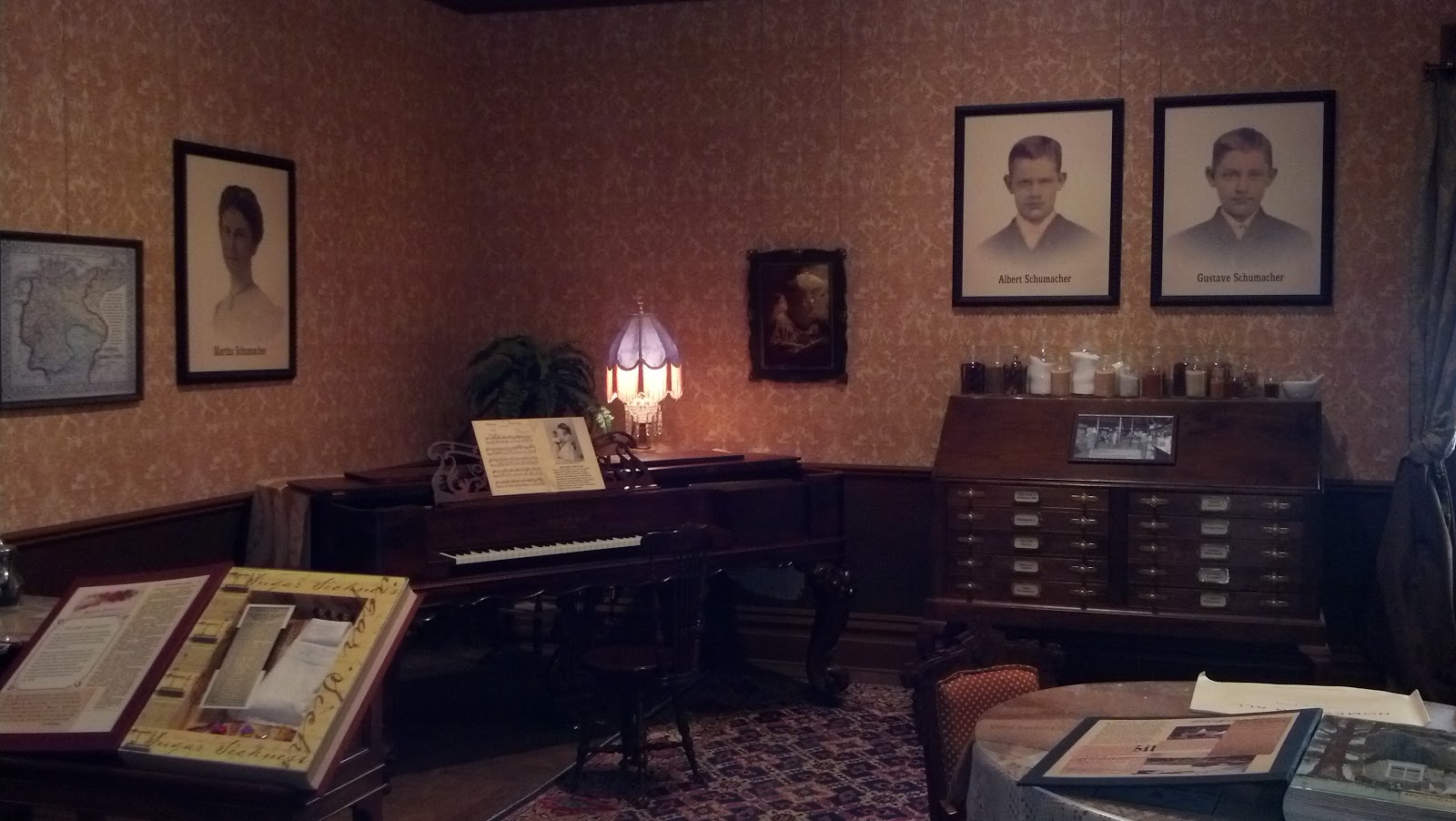
The house is 470/472 Hopkins Avenue, in east St. Paul, and was sort of randomly chosen by the museum as a method to show that everyday people are part of history.  The home was built in the 19th century by a family named Schumacher who were upper middle class German immigrants and who lived there as a single family residence.  In 1923, the family sold it to two Italian cousins who converted it to a duplex, one side for each cousin's family.  This part of St. Paul became a "Little Italy" in the 1930's with lots of Italian immigrants.  After World War II the building was converted to a triplex and has housed people with a variety of ethnic backgrounds, including the Hmong people who resettled in the Twin Cities following the Vietnam War.  The Open House exhibit attempts - with a large amount of success - to track down the names of everyone who's ever lived there and interview a number of people.  It's a very interesting concept for an exhibit and really helps someone understand his or her city's history.

Here's part of the exhibit:


The next day, you may not be shocked to learn that I tracked down the house:


As I took the picture, I wondered whether the people who live there now have gotten used to local history nerds photographing their house.  Or, perhaps, I'm the only one.  Hard to say.

One last shot of the History Center, for Jini's sake, because she wanted me to represent Minnesota in my chronicle of aviation history. You see, Charles Lindbergh was from Minnesota.  I didn't know that, but when I thought about it I realized, "his name is Lindbergh - of course he's from Minnesota."  The museum has Lindbergh's early plane, Jenny.


After a delicious lunch, I bid goodbye to Jini and Don and decided to spend the afternoon taking in a bit more of St. Paul.  This whole traveling thing is made a lot easier by the existence of the Interwebs and, more specifically, mobile technology.  There's a great website/app called Trip Advisor where you can just hit a couple of buttons on your smartphone and voila, there's a list of things to do in your area plus reviews of them by other travelers.  Using this, I found the Landmark Building in downtown St. Paul which is home to a couple of actual museums and a ton of history.


The building was originally the Federal Courthouse, and is actually where Supreme Court Justice Harry Blackmun began his judicial career.  There are still some federal offices there, along with a number of non-profits, two of whom have small museums.

My initial reason for going was to see the Schubert Club Museum of Musical Instruments.  I'm still unclear as to what exactly the Schubert Club is, but the museum itself includes a number of historic pianos.  For instance, the first grand piano, built by John Broadwood in the late 18th century.


Or Liszt's favorite piano:


Or pianos that are just beautiful:


But as luck would have it, the Schubert Club wasn't even my favorite museum in the building, because the Landmark Building is also home to the American Association of Woodturners.  They have a small museum featuring lathed pieces by their members.  Beautiful work.  These pictures won't do them justice but they give you an idea.


Both museums are technically free but they do accept donations.

The rest of the building is also a museum of sorts, with signs all around explaining some of the historical events that occurred here.  Here's a surprise:  I was intrigued by a Supreme Court antitrust case involving the railroads.  James J. Hill, St. Paul's biggest businessman at the turn of the century and owner of a couple of railroads (you can tour his mansion on Summit Avenue but I didn't - after all, I've already been to Biltmore) got into a bidding war with Edward Harriman (of the Union Pacific) over control of Hill's companies and Hill created a holding company (also called a trust) to prevent this from happening again.  Teddy Roosevelt's Justice Department sued under the Sherman Antitrust Act and the lawsuit went to the Supreme Court which ruled that the holding company posed a direct restraint of interstate commerce and thus violated the Act.  Depositions for this case were taken in the St. Paul Federal Building.  Anyway, I think that's very cool but we established long ago that I am a nerd.

Because of the freakishly late winter, there were some things in the Twin Cities I didn't get to go (i.e., things that required going outside), so I imagine I'll make a point of returning some year in July, after the snow has mostly melted.