Monday, March 18, 2013

Girl in the North Country

You'd need a calendar to know that Thursday is supposed to be the first day of spring.  I mean, you're not going to remember it just by looking outside and for sure you're not going to know it by stepping outside.

My friend Barb, who's lived in Minneapolis for more than a decade, says that by mid-March it's supposed to be in the 30's and 40's here.  I want to tell her that saying this to me is preaching to the choir and she really needs to direct her comments to Mother Nature, but that seemed rude, particularly since I am her house guest.  And after all, she has to go out in this stuff and I don't.  Anyway, I really didn't expect great weather when I decided to pop up to Minnesota in March, and it's safe to say those expectations have been met.

But beyond the weather, it's been a great trip.  I've seen a couple of wonderful museums and had all sorts of culinary adventures.

The Museum of Russian Art is the only museum dedicated to Russian art in the western hemisphere.  Their exhibits rotate every few months and I saw a collection of several dozen forged brass icons, a number of paintings from their permanent collection, and a large exhibit of modern Russian art.  You can't take pictures in the museum but the icons were so impressive that I wanted you to see them.  The one pictured on the left has blue enamel on it, and the others are most likely brass with gold added.

photo credit: www.TMORA.org
My paternal great grandparents came from Kiev, but my Russian heritage wasn't people to whom Christian icons spoke (other than possibly, "get out or we'll burn your house down").  Still, they're beautiful pieces.  (This summer the museum is bringing an exhibit called "Jews in Tsarist Russia" which should also be interesting.)

Apparently the museum's most popular painting is "Milkmaids - Novella:"

photo credit: www.TMORA.org
It's a large painting and I have to say it was my favorite as well.  It obeyed the "Socialist Realism" directive of the time that art had to show happy workers.  This picture does so, obviously.  But it's more than that: there's just something so universal and real about the women's smiles and laughter that the spirit is infectious.  And, of course, one can be as subversive as one wants to be in deciding what the women are laughing about.  So long as you kept that to yourself.

As you know, I love historical museums and have seen a bunch of them over the past four months.  It's difficult to pick a favorite, but for sheer depth of focus and height of elevators, it's really hard to beat the Mill City Museum.

In downtown Minneapolis, built in the ruins of the Washburn-Crosby Company's A Mill, the museum explains and documents the development of the flour industry which is arguably the basis for the city's existence - certainly it is the basis for the community's economic significance. 

Up until the mid-19th century, flour in the U.S. was milled from wheat grown in the southern part of the country which had a soft outer shell that was easily removed during processing.  The climate in Minnesota and the Dakotas wasn't conducive to planting such "winter wheat" (see my comments at the top of this post) and the kind of wheat that would grow around here is called Red Hard Spring Wheat.  That means it is planted in the spring and has a hard shell.  And it's red.  In about 1850 a couple of guys from New England, who had moved to Minnesota to harness the power of the Mississippi's only waterfall and make textiles, figured out the secret to milling hard wheat.  Even better, they learned that such wheat was superior for baking bread, and the next eighty years saw Minneapolis become the Flour Capital of the World.  One of the docents Cousin Susan and I spoke with, T.J., said that he felt that this site - the Washburn A Mill - was the most important building in Minneapolis history, since it was in this building that the milling process was developed.  The A Mill had exploded in 1878 (flour dust is more explosive than TNT - the explosion killed eighteen people, destroyed one-third of the area's milling capacity and was felt miles away) and was rebuilt in 1880.  General Mills (successor company to Washburn-Crosby) made Gold Medal Flour there until 1965, when the plant fell victim to decentralized production and was shuttered.  In 1991 a fire gutted the property but luckily, Susan explained, the head of the state historical society and the mayor worked to save the site and, in a sense, the city's history.

Part of the museum is called the Flour Tower.  You and about three dozen people sit in a small room and your docent explains that you'll be hearing former mill employees talk about what it was like to work there.  If you are among the dimmest of the patrons, as I was, it's not until then that you realize that you aren't in a small room so much as you are in a large elevator.  The "room" moves up and down to various floors and you see everything from the office to the boilers.  It is very cool.  The rest of the museum is very well done, too, with some exhibits for kids and lots of information about the history of the industry:  foreign trade, millwrights, Betty Crocker - the works. 


You also get an awesome view of the Mississippi River and Minneapolis.

Last but not least, there's a movie called "Minneapolis in 19 Minutes Flat."  It's an entertaining and very informative history of the city.  I will illustrate my respect for your intelligence by not describing the movie's length.

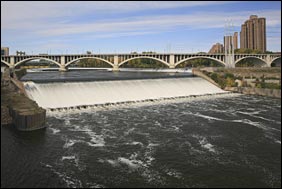
The area that became Minneapolis was identified by a priest named Hennepin when he came across what he called "St. Anthony Falls" - the only natural waterfall on the otherwise-very-flat Mississippi River.  Here's a picture of what the falls looked like before it was heavily developed:
Photo credit:  http://www.uh.edu/engines/earlystanthonyfalls.jpg
Here's what it looks like today:
Photo credit:  http://www.nps.gov/miss/planyourvisit/images/stAnthonyFalls.jpg
So if you're in the Twin Cities you definitely want to check out both The Museum of Russian Art and the Mill City Museum.  You will not be disappointed.

Of course, a person cannot only feed one's mind.  She must also feed her stomach and there are a lot of great places to do that in the Twin Cities, as you would expect.

We did have a little trouble with that Friday night, however.  My friend, Barb, and her husband, Tim, and I, spent quite some time trying to decide where to go to dinner.  There are too many choices, really.  We finally decided to try a new place called Piccolo's which had gotten rave reviews.  Their slogan is "putting what is seasonal and creative ahead of what is safe and familiar."  We're all for that!  Unfortunately, what we didn't realize until after we'd gotten settled in and ordered a bottle of wine is that they are into this whole "small plates" movement.  Friends, if you are like us and didn't understand what that means, it means that each dish has about the amount of food on it that you'd get from a waiter passing hors d'ouevres at a cocktail party.  Yes, I know that most American restaurants give you way too much food and generally I wish they'd serve smaller portions.  But there's a difference between a reasonable serving and a bite-sized morsel.  Once we realized this, Tim and I each ordered one plate and we told the waitress we would just be having that.  I've never seen a waitress change her disposition so quickly.  We wanted to say, "Look, dear, you did not have anyone else waiting for this table.  Treating us like something on the bottom of your shoe is not a good way to maximize your tip.  And did I mention I just ordered a ridiculously expensive bottle of wine?"  But this is Minnesota, after all, and we're all much too nice to say such a thing.  When we finally finished the wine and left (quickly - before we started laughing), we found a fabulous Greek place with food that did not need to be explained and in quantities that didn't make you look around for dessert.  And in Piccolo's defense, the food was delicious.  In a diminuitive sort of way.

Sunday morning we faced no such dilemma.  Barb said that we'd be going to this really good place, which she refused to describe, and Tim said we needed to leave in plenty of time to be in line when they opened at 10.  Great call on all counts.  They took me to the Triple Rock Social Club which is a punk bar (the Clash played here) that serves wonderful brunch on weekends.  This is no "small plates" place and the waitress had no sneering attitude.  She did, however, have a lot of facial tattoos.  I had the house specialty, called a Mother Trucker, which included home fries covered in cheddar cheese (real cheese, not some nasty cheese sauce).  Awesome - and I needed that much food to help counteract an extremely strong Bloody Mary.

Then we walked through the Como Park Conservatory because it was very nice to get in from the cold.


That's not all of Minneapolis, of course - Cousin Susan took me into the Guthrie Theater and Barb took me to a great international market and I spent Friday driving around seeing all sorts of places and eating at Cecil's Deli - and I'm not done yet.  Tomorrow I am going with the Washburns (no relation to the Gold Medal people, I don't think) to see another museum with an exhibit about Minnesota and the Civil War and of course I will give you a full report.

In the meantime, the snow has stopped here and the sun is trying to at least brighten up the sky a bit.  I hope that wherever you are is showing similar signs of effort by Mother Nature to kick spring into gear.

Friday, March 15, 2013

Catching Up

It's been a fun week since we last talked.  Actually, more like eight days, but who's counting?  I've been visiting friends and family more than touring, and as you've figured out I don't do a lot of blogging about my visiting activities - because, and I hate to say it so bluntly, my visiting activities are none of your business, really, and I'm saving all the good stuff for the novel* - but I've seen some cool places as well.

There are so many times when I am driving that I wish I had a magic camera which would automatically record what I am seeing, since it is often not possible to stop to take a picture.  The morning I left North Carolina was such a time.  It was foggy, and the gray softness skirting the eastern edge of the Smokies was so beautiful it took my breath away.  Driving on my Least Favorite Interstate, I-40, also took my breath away but not so much from the scenery.  Don't get me wrong, it's a gorgeous drive through the mountains, but the presence of massive numbers of semi's inspired fear more than awe much of the time.  Still, I made it through without incident and crossed into Tennessee.

Here's the view from the Highway 25E scenic overlook on the way down from the Smokies.


The valley is Bean Station, one of Tennessee's earliest white settlements.  It was founded by William Bean who built Bean Fort and, in front of that, the Bean Station Tavern, which was the largest tavern between Washington DC and New Orleans.  It must have been quite a tavern and hosted several presidents.

That picture gives you an idea of how beautiful it is in Tazewell, the small town in Northeast Tennessee where some of my in-laws live.  It's just south of the Kentucky line, and we drove to Cumberland Gap which is only a few minutes away.

There's an Iron Forge in Cumberland Gap which is a large stone furnace built for the use of people coming through the Gap who needed tools of various types.  Now it's a great trailhead from which my sister-in-law and niece and I took a short hike.


As on the other side of the Smokies, the recent spring snow had melted quickly and turned often dry creekbeds into rushing streams.  Very pretty, although for reasons I no longer remember, I don't seem to have any pictures of them.  Sorry about that!

So I worked my way north, stopping in Louisville, Noblesville, Fort Wayne, and Berrien Springs, to see various friends and family, and then drove through Chicago and Wisconsin on my way to the Twin Cities to see more friends and family.  (Aside:  is there a more spiritually desolate place on earth than Illinois between Chicago and the Wisconsin line?  At least West Texas had weird earth formations and a soul.  There's something about post-suburban Chicago that makes a person - or at least me - want nothing more than to keep going.)

On the way back next week, I'm going to stop in Wisconsin for a couple of days to check out Madison and who knows what else.  I did see a couple of interesting things that I want to explore, including some giant and seemingly random rock formations in Wisconsin.  If anyone knows anything about these, please comment.

Some of you may know that Indiana Highway 9 near Huntington is called Highway of the Vice Presidents.  This has always struck me as sort of pathetic.  It just seems like you're aspiring toward, I don't know, second place.  That's not a very nice thought, and it is somewhat colored by my disrespect for a particular former Vice President from Huntington, but I have a lot of thoughts that are not very nice so there you go.

Anyway, I thought about the Highway of the Vice Presidents as I saw a billboard for Menomonie, Wisconsin.  The billboard proudly proclaims that Menomonie is the 15th Best Small Town in America.  Does anyone else think that Sinclair Lewis would have had a field day with that slogan?  I guess I would have suggested something more along the lines of "Menomonie - one of America's best small towns" but hey, that's just me and I'm nobody's publicist.  Sometimes I see this sort of thing and I can't get it out of my head.

Not coincidentally, I suppose, I've been listening to a CD of Hunter S. Thompson's The Rum Diary, which is about his time in Puerto Rico in the late 1950's.  That man could write, particularly before the booze and the drugs destroyed his ability to be coherent, and I feel nearly inspired.  To write, that is, not the booze and the drugs part (don't worry, Mom).  Thompson writes stuff that I wish I had written, such as:  "It was the tension between those two poles - a restless idealism on one hand and a sense of impending doom on the other - that kept me going."  His descriptions of people and places tend to focus on the dark side and perhaps that's what makes them illustrative, interesting and spot on.

But enough hero worship.  The early morning precipitation in Minneapolis seems to have dissipated and I am going to check out a few places before my friend, Barb, and her husband come home from work.  I hate to waste a day, usually, plus if I stay here I'll eat all of the large unlocked Tupperware container of Chex mix which she left, rather foolishly I thought, in plain sight.


*This may or may not turn out to be a complete lie.

Thursday, March 7, 2013

Gone to Carolina, Part IV

"Off-season" at Biltmore means the tickets are cheaper, the gardens are bare but not barren, and your dining options are limited but still ample.  "Off-season" in Bryson City, North Carolina, at the southern end of Smoky Mountains National Park, means that there's just not a heck of a lot to do.

I'm not really complaining.  Mostly I am on the way to see family in eastern Tennessee and the way you get there from Asheville is, luckily enough, through the Smokies.  I had anticipated spending a couple of days based in Gatlinburg, on the Tennessee side, if for no other reason than to get a head start Friday morning when I head north.  But the snow on Wednesday made me nervous about driving through the mountains so I figured I could still get a taste of the Smokies in Winter from the east side.  And I think I have.

For instance:

Deep Creek Trail
And this:

Toms Branch Falls

And this:

Indian Creek Falls
Beautiful no matter what the time of year!  I've been to the Smokies in July, and obviously the beauty in early March is more, um, subtle, but it's not hot and there are no crowds.

Those pictures are from Wednesday, the day it snowed.  Apparently depending on where you were in the area, you got one to six inches of snow.  It was nearly all gone by the mid-afternoon and only a few roads were still wet.

Temperatures rose slightly on Thursday, into the high 40's, so the snow was mostly gone when I hiked around.  I got a kick out of this path because water was running down it (which you can kind of see in this picture) and it seemed to be the complete opposite of the Rio Grande.

Walking Path
Also on the south side of the park is a historic building:

Mingus Mill
This is an old turbine mill that was operational until the owner (not named Mingus, by the way) sold it to the Feds during the Depression.  In the summer they have demonstrations of it.

Ah, the summer.  When every place is open.  Dare to dream.

Okay, that's not entirely fair.  There are places open, just not every place.  For instance, I wanted to see the Museum of the Cherokee Indian in Cherokee, North Carolina, on the Cherokee Indian Reservation, and a coldish day like Wednesday seemed like a good day to do so.  But it wasn't open - I found out later it was because of the weather that day and that normally it's open.

Cherokee is an odd kind of tourist trap: a combination of Smoky Mountain activities (motels, tubing trips) with more moccasin shops than you can shake a stick at. And if you want a carved stick, they can take care of that, too. Lots of Indian-themed stores which I frankly didn't have the energy to explore.  They just seemed too kitschy.

Fortunately the museum opened on Thursday so I was able to visit.  It's a beautiful museum - Harrah's, located down the road, is a sponsor, so it's not a hand-typed-notecard sort of place.  They do a really interesting job of intertwining Cherokee heritage - and by that I mean mythology and stories and art - with history - and by that I mean the Western view of history, with names and dates.

And if you've been around for 11,000 years, you've got a lot of stories to tell.  Unfortunately for most of the Cherokee, those stories ended in tragedy either along the Trail of Tears or at the end of it, in Oklahoma.  The Trail of Tears was the forced relocation of the Cherokee (along with four other tribes from the southeastern U.S.) in the 1830's.  (Interestingly, you can actually walk parts of the Trail of Tears which are scattered in several states.  The National Park Service has a handy guide here.)  The Creeks and the Seminoles lost roughly half of their population who died along the way.

Remember John Ross?  Principal Chief of the Cherokee Nation?  Right, that John Ross.  We met him outside of Chattanooga, in Rossville, last month.  Anyway, his wife shared her only blanket with a sick child and ended up dying on the forced relocation.  She was one of an estimated 4,000 to 8,000 Cherokees who died during the relocation.

I've been to Oklahoma, and let's just say that its countryside isn't exactly lush.  It's flat.  There are no forests to speak of.  It's dry.  To move people who view nature as an integral part of their lives from someplace like the Appalachian Mountains to someplace like Oklahoma is beyond cruel.  And of course, there's the whole "leaving behind everything you have and traveling hundreds of miles without much in the way of food and shelter" thing.  But then again, I haven't yet found any history of U.S. Indian policy that makes me proud.

There was some irony to the Indian Removal, as it was called.  ("Removal" is a pretty neutral word, don't you think?  Other than the fact that it's used to describe actions taken against human beings, it all sounds very sanitary.)  Anyway, in 1814, the life of Old Hickory himself, Andrew Jackson, was saved at the Battle of Horseshoe Bend by a Cherokee named Junaluska.  I guess Jackson didn't seem to feel this was a favor to be returned to Cherokees in general, because it was under his Presidency that the forced relocations began.  Junaluska was quoted as saying that if he'd known what Jackson would later do, he wouldn't have saved his life.  I think that's fair.

So, you may ask, if all the Cherokee were relocated to Oklahoma, why is there a Cherokee reservation in North Carolina?  The short answer is, they weren't all relocated.  The longer answer is more interesting.

In 1817, a 12-year old white orphan named William Holland Thomas arrived in the area where he was eventually adopted by the Cherokee Chief Yonaguska.  As a child, Thomas worked in a trading post and became fluent in Cherokee.  As an adult in the 1830's, he served as attorney and advisor for the Oconaluftee Cherokees and helped keep them from being relocated.  After the Civil War (in which he fought for the Confederates and led a unit of Cherokees; they were attacked near Bryson City according to the historic marker I saw) he was able to purchase land that eventually became the Eastern Band reservation which exists in Cherokee today.  (Interestingly, while Wikipedia calls him a chief, the museum calls him an "unofficial chief."  I guess I'll go with the museum on this one.)

There's a lot more history described in the museum, including a trip that several Cherokee leaders took to England in 1762.  If you're ever in the Smokies, drive over to the museum and take a look around.

Cherokee is a beautiful language to look at.  The street signs in the town are in both English and Cherokee, and there was even a billboard in Cherokee.  Here's what the language looks like.  Of course, I have no idea what this says.  I'm just putting it here so you can see it:
Credit:  http://ani-kutani.com/13moons/13-moons-page1a.jpg
Most of the time when you drive through an Indian reservation you don't see much.  At least, that's my experience in the west.  The reservations are pretty rural and the main roads generally don't go by towns - lately, of course, they tend to go by casinos, but that's a recent development.  So I was fascinated by Cherokee and I'm glad the snow kept me on the eastern side of the Smokies for another couple of days.

Tomorrow, north to Tennessee and then Kentucky and then Indiana to see some family.  Catch you in a few days!

Wednesday, March 6, 2013

Gone to Carolina, Part III

Sometime you just need a good snipe hunt.  Yesterday in Asheville, what with the rain and all, was such a sometime.

I'll admit that my primary curiosity about the Southern Appalachian Radio Museum was why it existed in the first place.  Asheville is not known for its electronics industry, after all.  I'd seen the museum listed on Trip Advisor and the fact that there were no reviews of it should have been, as they say, a clue.  But it's not like I was going to go hiking in the rain or anything so I set out to find it, armed with my trusty Droid and pretty good 4G cell coverage.

The museum is housed inside the Asheville community college campus, which made finding it somewhat challenging.  Luckily I knew from Trip Advisor that it was in the Elm Building and a friendly security guard let me park nearby.  Arriving at the Elm Building, I stuck my head in the first occupied office and asked where the museum was.  One lady had no idea they even had a museum but her officemate did, and directed me to the third floor.  On the third floor, I looked around a little and found a nice electronics techie guy who took time out from helping a student to show me where the museum was, down a hallway without benefit of signage.

It's only open Fridays from 1 - 3 p.m.  The window is as close as I got.


As you can see they've got a bunch of old radios, and this is Southern Appalachia, so the museum is well-named.  I've subsequently checked their website and it does clearly state their hours of operation.  Still, I don't have a definitive answer to my "why" question.  It may be as simple as somebody had a bunch of old radios and his wife (I'm comfortable profiling here) told him he had to get them out of the guest room.  Having a museum lets him keep collecting without marital conflict.  That's sort of the origin of the Wizard of Oz Museum (although in that case I don't know about marital conflict or, if so, whether a wife was involved).

But I was not terribly disappointed that I couldn't see the museum.  Sometimes the hunt itself is really all that matters.

The radio museum now beats out the F. Scott and Zelda Fitzgerald Museum in Montgomery and the Irish Cultural Museum of New Orleans for shortest hours of operation of any museum I've encountered.  I wasn't able to see those, either.

Too bad about the Fitzgerald museum in particular, because then I could have compared it with the Thomas Wolfe Memorial.  In downtown Asheville, their visitor center is next door to an old 6,000 square feet boarding house where author Thomas Wolfe grew up.  Called "Old Kentucky Home" (the owner prior to Wolfe's mother was a retired Kentucky minister), Wolfe lived there from 1906 until he left Asheville for college in 1916.  It is the inspiration for his classic novel Look Homeward, Angel.  I like early twentieth century American writers but will confess I've never read Wolfe.  His stuff always seemed pretty depressing; since his childhood was, in the words of our docent, Jim, "dreadful," I guess he came by it honestly.  Wolfe's father was a violent depressive with an unfortunate tendency toward drunkeness.  Wolfe lived in the boarding house with his mother, a driven and largely successful businesswoman and real estate speculator who purchased the boarding house as a way to generate cash for her real estate investments, but who wasn't much of a mother to her youngest son.  (Wolfe was born in 1900 and was the youngest of eight children.)

Here's a picture, mostly just to break up all of this text.


The coconut is from one of the trips that Wolfe took with his mother to Florida.  Despite being pretty unattentive (regular meals, for instance), she did instill in him a love for travel.

The subtitle to Look Homeward, Angel is "A Story of the Buried Life" which I like a lot.  Everybody has a buried life, I think.

Anyway, when the novel was published in 1929, Wolfe became most unpopular in Asheville (called "Altamont" in the book, and the boarding house was called "Dixieland").  Jim said that there were even death threats - Wolfe apparently made it clear that part of his purpose in writing was to settle some old scores and I guess he did that.  (He went on to write quite a bit more before his death just three weeks shy of his 38th birthday in 1938.)

The tour was a really interesting way not only to learn about Wolfe but also about Asheville and boarding houses.  For instance, both Wolfe and his older brother, Ben, contracted tuberculosis (which eventually killed each of them), presumably from boarders.  Many people with TB came to the mountains in those days, and it was illegal for them to live in regular rooming houses due to public health concerns.  Still, there were a lot of TB patients and Julia Wolfe (along with many other boarding house owners) was not going to turn away their cash, so a number of people with TB lived at Old Kentucky Home.

Tourism in the region is nothing new, and Jim said that since the forests were logged out at the turn of the last century, it's been the primary industry in the area.  (Asheville's beauty, of course, is what brought George Vanderbilt here.)

Originally I'd planned to pass on the Wolfe Memorial, but I'm glad I found it.  Sometimes these snipe hunts turn productive.  In fact, I'd say that they usually do.

Planning your trip around weather can be as successful as trying to time the stock market, but I've done pretty well in Asheville so far.  I went to Biltmore on the nicest day (sunny and 50's - not too shabby for early March).  And I chose another sunny (although colder) day for driving the Blue Ridge Parkway.  This is a 469-mile road that runs from Roanoke, Virginia, to the Smoky Mountains National Park.  When it's all open, that is - right now you can't get north of the east side of Asheville or south of the west side due to construction.  But that's okay, it's still a nice drive around town and you can get to the Folk Art Center which is another must-see if you're in the area.  It's a lovely museum with a wide variety of beautiful pieces - pottery, textile, wood, and so on - plus there's a nice gift shop.

Something about Asheville that I neglected to say in earlier posts, is that because of its relative poverty for most of the 20th century, a large part of its downtown is relatively intact, leading to the existence of buildings like this:


And, of course, it IS North Carolina, so one shouldn't be surprised by the use of basketballs in public art.  Cute, huh?


Weather permitting, later this morning I am headed to or through the Smokies for a couple of days, then up to eastern Tennessee to see family.  If the roads are good, I'll go to Gatlinburg and if they aren't, I'll stay on the North Carolina side of the mountains until the end of the week.  What I'm saying is that there may be a Going to Carolina Part IV in our blogging future.  Stay tuned.

Tuesday, March 5, 2013

Gone to Carolina, Part II

Everybody says that you should go to Asheville.  I'm now part of everybody, I guess.  (Fascinating aside:  a person recently told me that you shouldn't actually reside in Asheville; she said that the area has such "transitional energy" that everyone she knows who lives there has gone through major negative life changes while in the area.  I cannot provide data on that one, but she cited several examples.)

Asheville is the largest city in western North Carolina, with about 84,000 people but in a metro area that is over 400,000.  It seems like a city of about 200,000, if that gives you any sense of it.  In any event, it's big enough that there is a lot of diversity in how the community looks and feels.  There is a huge arts community.  The River Arts District, for instance, is a bunch of old industrial buildings that are being used as creative and gallery space by a wide variety of artists.

One such place is a glass studio where you can take a 30-minute mini-workshop on glass blowing.  This is what I made:


Isn't it fabulous?  I call it "Glass Cup."  It was very fun and luckily John, my teacher, was patient and helpful.  Here are the artists at work:


I've had some odd "small world" events lately - like when I randomly started talking with a woman at Fort Sumter whose husband taught at my high school in Omaha - but the weirdest one so far has to do with John, my glass mentor.

After I finished my masterpiece I put on my Fort Wayne International Airport bomber jacket.  John noticed Fort Wayne and we started talking.  Long story short, he is good friends with Russ Jehl's sister, Renee.  This is the same Russ Jehl who succeeded me - that's a nicer way of saying beat me, but it's the same thing - on City Council.  Now THAT is just too strange.  So I e-mailed Russ and he confirmed that, indeed, his mother does have a glass statue that John made.  Just goes to show that you need to be nice to everyone because you never know when your hands will be a foot away from glass hotter than molten lava and you'll be relying on the kindness of the friend of a friend for protection.

In addition to art (and the related concepts of a cute downtown, vegetarian restaurants and coffee shops that emphasize fair trade coffee), Asheville has a lot of regular looking places.  I'd even go so far as to call them unattractive.  Just older suburban type development - nothing special at all.  This actually made me like the city more, because it feels more real and less like a theme park.

Asheville is also home to Biltmore.  That is just "Biltmore," without the need for a "the" in front of it.  Simple.  Elegant.  Some of you less serfistercated people might know it as the Biltmore Estate.  This is the 250-room home of George Vanderbilt, built in the 1890's, and currently the largest private home in these United States.  To say it is amazing is to err in understatement.  My father might say "unbelieveable" but he would also add a two-syllable word between "unbe" and "lieveable."  And even that would be too modest in its description.

Any home where you drive three miles past the entrance to get to the house, and the entrance looks like this - well, you get my point.


Luckily you can't take pictures in the house.  I say "luckily" because I'd have spent weeks in there trying to get just the right shot and would have been ultimately unsuccessful anyway.  I don't think photography can capture it.  There's a Banquet Hall (capitalizations are intentional) that is seven stories tall.  Seven stories.  Tall.  For dinner.  The room is built of stone and draped with authentic Flemish tapestries from the mid-1500's and has honest-to-God thrones.  It has fireplaces where the hearth is taller than I am.  And oh yeah, a pipe organ the size you'd find in a cathedral.  No kidding.

The servants' quarters are larger and have better views (of the Smoky Mountains) than the early homes of Presidents Eisenhower and Johnson.  And lots of other people.  Most other people on earth, I'd dare to say. 

There's a Library (Vanderbilt was an avid reader) with 10,000 books - which is only about half of his collection.  The 43 bathrooms were remarkable for the day when most people didn't have running water, and although they were very modern they did not contain sinks because why would you want a sink when a servant would bring you a nice bowl of warm water with which to wash? 

There's an indoor swimming pool and a bowling alley and a gymnasium.  There's mechanical refrigeration (again, very modern for 1895). 

The home sits on 8,000 acres.  Of course, that's smaller than it was in 1895.  Vanderbilt was among the earliest practioners of forestry and owned all of the mountains that you can see from the property.  Did you read that correctly?  I said "all of the mountains that you can see."  That's three layers deep of mountains.  When George returned from their honeymoon with his wife, Edith, who had never seen the property, she was greeted by bonfires that had been lit at the top of each peak.  (After his death, Edith sold the mountains, about a half million acres, to the Federal government at a reduced price with the requirement that the land be conserved.  Today it is the Pisgah National Forest.) 

Here is what their Greenhouse looks like (it was too big for me to get it all in the picture):


"Over the top" doesn't even begin to describe the place.

For understandable marketing reasons, their website doesn't have a lot of pictures so I can't direct you there to see it.  They want you to fork over some pretty hefty coin for the tour (it's $45 per person off season) and if you could see it all on-line, you might be tempted to avoid the time and expense of going in person.  Don't.  It's worth the trip.  You can make a day of it:  there's walking paths and water and a small museum and a winery with free wine tasting; you can rent bikes and boats, among other activities.  Here's the Bass Pond from a couple of angles.


Their winery ("the most visited winery" in the U.S., or on earth, or somewhere) used to be the dairy for the estate.  Of course I wholeheartedly support this important and visionary reuse.

I'm not going to give you the history of the place, other than several points which I found interesting:
  • George Vanderbilt, the youngest son of William Vanderbilt (who took his father's $100 million and doubled it in the 1880's - take that, Warren Buffet), was a bachelor when he built the home in the 1890's.  He wanted a house that would be a retreat for himself, his siblings and their kids - and if it were bigger and better than those estates owned by his older brothers and sisters well, there's nothing wrong with that.
  • George, Edith and Cornelia (their daughter and only child) were in Europe in 1911 and had planned to return to America on the maiden voyage of the Titanic.  At the last minute they changed their mind and took an earlier ship, the Olympic.  Whether their change of heart was due to other family members being aboard the Olympic or trying to avoid an impending coal strike is unknown.  Regardless, in hindsight it was obviously a good decision.  Although Edith and Cornelia would probably have survived the wreck (first class women and children first, after all), only about a third of the first class men made it home.  Tragically, one of their staff stayed behind to finish packing and therefore was on the Titanic where he perished.
  • Cornelia married John Cecil, a British diplomat, in 1924 and they ran the home for a decade.  In 1930 they opened the property to the public to help support the estate and also encourage tourism for the Asheville area, which was particularly hard hit by the Great Depression.  They divorced in 1934.  Interestingly, while Cornelia spent most of the rest of her life in England (she died in 1976), John remained at Biltmore and played "a significant role in management of the estate" until his death in the 1950's, according to the museum there.  The property is still owned and managed by the family - with the help of about 1,800 employees, each of whom is friendlier than the last.  Really - they take hospitality seriously at Biltmore.
Here are a couple of tips I'll give you - at no additional charge - about visiting:
  1. If you're not a huge garden person, you can save a bunch of money by going off season (January 2 until mid-March).  Plus I'm sure the crowds are more manageable.  But if you're big into gardens, wait until late spring or early summer and just recognize that you'll pay more and most likely deal with more visitors.
  2. Unless your kids are incredibly well behaved and patient and don't get tired (i.e., they're not really kids), I'd say come without them.  Don't get me wrong - I like kids and the ones I saw at Biltmore were all very nice.  It's just that if you're going to get your money's worth you'll want to see nearly everything, and an hour and a half in wandering through a big house, where you can't touch anything, is a lot to ask of a kid.  I heard one lady say to another that she hadn't been able to see a lot on her earlier trip, "because my kids couldn't tolerate it."  Of course, you could always bring a spare adult who could watch the kids run around outside while you tour the house, and then trade off.  You're not getting near the house, however, without a ticket, so your babysitter needs one, too.  The Cecil/Vanderbilts are no fools.
Today it's been raining in Asheville, but I don't mind because I found a wonderful little coffee shop with yummy muffins and working wi-fi.  Still, I miss the Firefly.  Some days, there's no place like home.

Gone to Carolina, Part I

Let's just get this out of the way first:  I know that there are terrible drivers all over, of all colors, genders and ages.  I know that I hated driving in Austin because of the rude drivers who seem to think cutting people off is a sport.  And I know that I'm still not comfortable driving on very busy interstates in big cities, particularly when I don't know where I'm going.

Still, based on nearly 13,000 miles of observation, I can definitively report that drivers in North Carolina are crazy.  To be more specific and borrow a phrase from my father, these drivers are nucking futs.  North Carolina is the center of NASCAR and apparently I-40 through the state - most of which is rural, but all of which is very crowded - is an Official Approved Training Track.  These people will zip in front of somebody just to cram up behind somebody else.  This was not just one or two people - it was like a NASCAR Wannabe Club.  It's remarkable, really.

Now that I've gotten that off my chest, we can talk about the good, less terrifying, things in the Tar Heel State.  Thanks for listening.

Completing the Great Aunt subtheme of the Driveabout, I had a nice visit in Durham with Aunt Ken - that is short for Kensington, her maiden name, and it rhymed nicely with Len, my great uncle's name, so we always have called her Aunt Ken although her given name is Eunice.  One of the great benefits of the Driveabout is catching up with relatives I haven't seen in decades, and it was nice to have dinner (gourmet shrimp and grits - it's the Research Triangle, after all) with her, her son Cousin Richard (who took us on a driving tour of Durham after dark) and his wife Carrick.  Aunt Ken lives near Duke, where Uncle Len worked and taught for decades, and she suggested that I check out the Duke Chapel and the Sarah Duke Gardens.  Good call on both.

I'm sure there is an ecclesiastical reason why the Duke Chapel is called a chapel rather than a cathedral, but the reason is not because the building is small.
photo credit:  TripAdvisor.com
This picture was taken (by someone, not me) from the front of the chapel.  Between the entrance and this spot, there are about seventy rows of pews.  The place is gorgeous and makes you think you're in Europe.

The Sarah Duke Gardens are equally impressive, even in the winter.  Of course there's not much blooming yet, but the gardens are still pretty.
Don't you agree?

And then, on to Asheville.

The three nights I stayed in Savannah were the longest I'd been in one place in a while, so I've been doing a lot of driving lately.  Perhaps because of that, the first hour of the trip west was tedious.  When I saw the sign for Alamance Battleground outside of Burlington, I decided it would be a good stop.

Civil War history buffs will know right away that I am not one of you because I didn't realize that Alamance was not a Civil War battleground.  Actually, explained Lisa Cox, the very knowledgeable and helpful ranger, there weren't many Civil War battles fought in North Carolina.  (When everything started collapsing, Lee had planned for his troops to escape to the mountains of Carolina for guerilla war, but didn't make it that far.)

Anyway, Alamance was one of those pre-Revolutionary War events that has become lost to time.  Or at least, lost to most of us - Lisa said that her child wasn't taught that history in school, and they live nearby.  Ever hear of the War of Regulation?  Me, neither.  When I think of the events leading up to the Revolution, I think of stuff that happened in Boston and Philadelphia (and now Charleston, but that's recent knowledge for me.)

Remember that in the 1760's, North Carolina was more or less the end of the earth.  Lisa showed me a map from that time that showed the two westernmost counties in the state not having western limits.  Seriously - the maps just showed north, east and south boundaries.  Many of the residents were farmers who mostly wanted to be left alone.  Too bad for them they were governed by a British-appointed baron type of guy with expensive tastes and the ability to collect significant taxes to pay for his parties.  A group of people called "Regulators" grew up - so-called because they wanted to regulate excess taxation and corruption.

One of their leaders was a Quaker named Herman Husband.  He tried to resolve their problems peacefully but since the court system was run for the benefit of the British, and since the royal governor wasn't interested in hearing about problems, he didn't get very far.  Specifically, he got as far as the local jail.  (His inability to find a nonviolent solution makes one even more impressed with a Martin Luther King, Jr., who could find one two centuries later.)

There was a battle, and not surprisingly since this was real life and not a movie, the well-armed militia (made up of North Carolinians drafted and supported by the British) crushed the smaller and poorly armed Regulators.  So ended the War of Regulation.  But some of the lessons of the war were used during the Revolutionary War which as we all know ended up a lot better for the Americans.

The historic battlefield site, not too far southeast of Greensboro, is run by the State of North Carolina and is really nicely done.  If you're in the area, you should definitely stop by.  In addition to information about the battlefield and visitor center, they have an original log home from the period.  It was owned by Husband's brother-in-law (this is where the name Husband seems a little funny, but that's neither here nor there), John Allen.  It is decorated with many pieces from the period including a number of pieces that belonged to the Allen family.  Unfortunately it was too dark inside to get any good pictures but here's what it looks like from the outside.


When I told Lisa I was from Indiana, she said that a lot of Hoosiers trace their roots back to North Carolina.  Mine don't, of course, but if yours do, Hoosier friends, this place is a don't-miss for you.

I don't know about you, but all this history has worn me out.  You'll have to check back later for the Asheville part of the Driveabout.  In the meantime, I hope that wherever you live hasn't been overcome by snow.

Wednesday, February 27, 2013

Palmetto Trees Saved Charleston - Who Knew?

The great thing about going on a side trip is that you tend to discover other side trips along the way.

There's been a lot of rain in the southeast - I know, it's not snow, I'm not complaining, just describing - so I didn't leave Savannah first thing Tuesday morning.  Once the rain let up I consulted the Roadfood book that Uncle Bill and Aunt Connie gave me, to see what was on the map for the South Carolina coast.  Sgt. White's Diner in Beaufort (pronounced Bew-fert) looked promising, so I took the way-scenic route, getting off the interstate just a few miles north of Savannah.  Then I realized I'd still be getting to Beaufort quite early for lunch - even by my standards - so I started looking for wrong turns, and found a couple. 

But as the song goes, if driving this way is wrong, I don't want to be right.  Or something like that.  Generally speaking, if I have the option to go toward anything labelled "island," I will do so.  And along the way I saw a sign for "Penn Center Historic District" which at first I paid no attention to.  A few miles - and random turns - later the sign popped up again and this time it was directing me off the main road so I followed it.

It was very, very interesting.

Penn Center is hard to categorize with a word more specific than "community."  It's a school (now a museum) and community center and some other buildings, and is located on St. Helena Island, one of the South Carolina Sea Islands.  It was designated a historic landmark in 1974 and celebrated its 150th anniversary last year.

The Sea Islands were captured (from the Confederacy) by Union troops in 1861.  The U.S. government urged the former slaves to support the government (not the least of which was for men to enlist in the Army, which many did).  While the government encouraged the former slaves to learn how to read and write, they had no resources to offer toward that end.  Some Quakers in Philadelphia learned of this and received government permission to set up the Port Royal Experiment.  They created a relief society to help the 10,000 former slaves in the Sea Islands.  Two women, a Unitarian abolitionist named Laura Towne, and a Canadian named Ellen Murray came to the islands to set up a school which initially was focused just on literacy but then became a vocational school as well.  It was the first such school for freed slaves.  A Massachussetts woman named Charlotte Forten sailed down to be a teacher.  Remember, the Civil War was still going at this point and although this area was controlled by Union troops, getting there was no small task.  Forten took the most risks - an African-American woman, she would have surely been sold into slavery had she been captured by the Confederates.

Their museum introduced me to the Gullah Geechee culture.  Even prior to their liberation, African slaves and their descendents far outnumbered the white population (ten to one, according to the Charleston Museum, although I don't want to get ahead of myself).  The slaves worked rice plantations and were pretty isolated.  (Even today with a car and a few decent highways, you really have to want to go to the Sea Islands to get there.  It's not exactly on the way anywhere, unless you're the liberating/invading force [depends on your viewpoint] coming in from the sea.)

Anyway, the language and culture of the people of the Sea Islands reflected that isolation.  Their language is a combination of English and various African languages.  Their literature, music, folk customs and art are strongly tied to African traditions.

The archetypal product made by Gullah artisans is the sweetgrass basket.  You've seen these before, but if you're like me you didn't know where they originated.  Here's a picture that I didn't take - it's from a Department of State website.

These baskets are really, really expensive.  A basket the size you see in this picture can easily be $150 to $200.  Apparently they will last hundreds of years.

At the Penn Center museum, I met Robert Middleton, who wrote a short book which I bought.  He's in his 80's (looks 15 years younger) and volunteers at the museum six days a week.  He grew up on a farm on St. Helena Island and was a student at the Penn Center school.  (His book is about his ultimately successful effort to locate his birth parents in, of all places, Philadelphia.)

There's a display about another Robert:  Robert Smalls, of Beaufort.  A slave, on May 14, 1862, he commandeered a Confederate ship (its three white officers were spending the night on shore) and piloted it and the 45 other slaves on board to the Union blockade outside of Charleston.  He served as a pilot for the Union through the rest of the war and eventually became a politician.  (This was during Reconstruction, when blacks were still able to vote in the South - a fact which several current U.S. Supreme Court Justices might want to keep in mind but that's just my opinion.)  He served on the 1868 South Carolina Constitutional Convention which introduced the first public education system in the south.  He was known as the "King of Beaufort County."  Interestingly, after post-Reconstruction laws had effectively ousted all of the black elected officials in the South (by the 1870's), Beaufort County retained a number of black officials in key offices until Smalls' death in 1915.

(Another notable Beaufortonian is author Pat Conroy, whose book The Water is Wide was turned into the John Voight movie about the area called  Conrack.)

All this, and I hadn't even gotten to Sgt. White's Diner yet!  If by any chance you ever find yourself in the Sea Islands, by all means run do not walk there!  (You won't be able to do either after you've eaten.)  The pulled pork, cornbread and southern vegetables were to die for (perhaps literally; I could feel my arteries clogging as I chowed down).  If I don't get out of the South soon, I will need to outfit the Vue with heavy-duty struts.

The other good thing about Sgt. White's is that it's right next to a bail bondsman, and you just never know when that will come in handy.

Sgt. White's Diner, on the left
Then I arrived in Charleston.  I love New Orleans, and was impressed with Savannah, but Charleston is one beautiful city.  And friendly.  And remarkably well preserved.  (Sounds like I'm talking about an old lady - sorry about that.)  The guy at the visitor center on the way into town, who happened to be selling carriage rides, told me that the one thing you had to do was take a carriage ride.  So I bought one, being in a highly suggestible mood after such a delicious lunch.

Tom, our licensed tour guide, introduced himself as "Tom, your licensed tour guide" and also introduced us to Edisto, his horse.  Tom (and Edisto) showed us around the oldest neighborhoods and the market area.  We saw homes that are valued at roughly $1.2 million per floor.  There is a lot of money in Charleston.  More on that in a minute.  Tom showed us a lot of Charleston Single houses.  These houses are one room wide, three back, with a porch across the whole house.  The front door is into the middle room.  The trick is that the narrow end is what faces the street so they have what are called "privacy doors" (pronounced like the British say, with a short i). 

Charleston Single House - the street is on the left, by the tree
Charleston was actually not a colony, at least not originally.  You may recall from your English history that in 1660 Charles II took back the government from Cromwell with the help of a bunch of noblemen.  In gratitude for their help, Charles II gave eight of them "Carolina" which was a very large segment of North America.  These eight are the Lords Proprietors (yes, the plural on both words is correct).  They originally (1670) settled a few miles up the road but couldn't defend themselves so moved to a more strategic position on the peninsula in 1680 which is where Charleston (Charles Town - get it?) is located today.

The history of Charleston is long and fascinating (for instance, it's one of only three walled cities in what is now the U.S. - read to the end to see if you can guess the other two), and I will only dwell on a couple of points.

The first is where the city's obvious wealth came from.  When I asked Tom about it, he said that people got it the old fashioned way, they inherited it.  That begged the question "where did their ancestors get it," of course, but at that point the tour was over and everyone was getting out of the carriage.  However, I spent some time at the Charleston Museum today investigating said question, and it turns out that a lot of the money came from rice.  The Lowcountry (all run together), is the name for coastal South Carolina, and Charleston is in all respects its capital.  Until the mid-19th century, the Lowcountry was a great place to grow rice.  The climate was good and the labor costs were, let's just say, controlled.  A number of white plantation owners made pretty good-sized fortunes up until the late 19th century when the Civil War, Emancipation, competition from mechanized production elsewhere in the South, and a couple of hurricanes effectively ended rice production in the region.  (South Carolina arguably had the economy most dependent upon slavery in the 1850's and it seems no coincidence that they were the first to secede from the Union.)  In addition, Charleston was one of the most important ports in the United States (and the Confederacy), and fortunes were made from the trade that happens in such a major port.  Including, I feel compelled to add, buying and selling people.

The second point is the Civil War.  As everyone who's been through elementary school knows, the first shots of the Civil War were fired at Fort Sumter in Charleston Harbor. I'm not going to rehash the history here, but I've got a couple of pictures and this is the part of the blog where I'm putting them.

Approaching Fort Sumter
A cannon's-eye view of Charleston (the dark line at the horizon) from Fort Sumter
Oh, there's a third piece of history I wanted to tell you which is why I titled the blog post the way I did.  Here's the South Carolina flag:

South Carolina Flag
Tom, our licensed tour guide, explained that it is blue because of the importance of indigo to the region's economy (I oversimplified when I talked about rice).  The crescent moon isn't really a moon, according to Tom.  It's a neckpiece worn by early American military officers.  And the palmetto tree isn't just there because it's pretty (although it is).  At the beginning of the Revolutionary War, they used palmetto logs, stacked like cordwood, to stave off the British and protect Charleston.

So next time you see something that looks like a somewhat romantic moonlit night, think twice.  It could be a revolutionary statement.

And the answer to the question about walled cities?  New Orleans and St. Augustine.  Now you know.