Saturday, July 13, 2013

Be a Tourist in Your Own Hometown

Fort Wayne has this program called "Be a Tourist in Your Own Hometown" where once a year all the tourist attractions are open for free on a Sunday afternoon.  The point of it is to expose people to all the fun stuff that they can do throughout the year and is based on a recognition that most people don't do tourist-y things except when they have family or friends in from out of town.  Maybe other places do this, too.  It's a good idea.

And its theory was proven true by all the places I went this week with my 16-year-old cousin Josie when she was visiting from Omaha.  We saw so many things that I had to make a list (in order of appearance) so as not to forget anything:

The Magnificent Mile and Watertower Place
Chicago Crime Tour
Willis Tower (formerly Sears Tower, which is what everybody still calls it)
Navy Pier
Shedd Aquarium
Museum of Science and Industry
Lincoln Park Zoo

We also did drive-bys of Millenium Park and the Buckingham Fountain, and went to the beach.  Twice.  Plus we drove through some of the North Shore suburbs on our way back from IKEA and the movies.

So, let us begin on Sunday when we took the bus to Michigan Avenue and explored the Watertower Place Macy's.  Although not the flagship Marshall Field's (which is on State, south of the river), it's a pretty nice store and much bigger than department stores Josie and I are used to.  For instance, they have an entire mezzanine level devoted to handbags.  Josie found a really adorable dress and then we had to hightail it across the street to meet the bus for our tour of Chicago's criminal history.  It was a pretty long tour.

Our guide was Will, a twenty-something kid with big glasses, boyish charm and a lot of energy.  He began with a history of Streeterville, which is the area where the Magnificent Mile is located.

Streeterville dates to the 1880's, when a would-be gun runner with a fondness for drink named George Streeter ran aground on a sandbar near Michigan Avenue.  He decided he would found his own community regardless of the actual ownership of the area and the fact that it was within the city limits of Chicago.  His story shows what you can do when you have no scruples or respect for anyone's authority but your own.  Plus his timing was excellent, as Chicago was still rebuilding following the 1871 fire.  Streeter charged builders to dump their construction debris and excess dirt onto "his" property.  There was a lot of such debris, and as the land filled in, he started selling it to people on which to build shanties.  This is what you call a win-win.  For Streeter, that is - not so much for the guy who actually owned the property whose lawyers and court documents were no match for the well-armed Streeter. Of course, as more families settled in Streeterville, thinking that they were legally purchasing land for their homes, there were a lot more people with guns to help run off anyone who tried to push them out.  Streeter was eventually convicted of murder but just served a few months and was pardoned by the governor - because that's how we roll in Chicago.

Of course Will gave us the full John Dillinger tour, including a stop at the Biograph Theater where Dillinger met his end with the Lady in Red.  She was actually wearing orange, Will said, but Lady in Orange doesn't sound very impressive.  I agree.  We drove by a speakeasy and the vacant lot that used to be a warehouse where the St. Valentine's Day Massacre occurred.  We stopped at a church which had to replace its steps because they had been so damaged by gunfire during Prohibition.

But Chicago's criminal history didn't end in the 1930's.  We drove by the Rock 'n Roll McDonald's where in the early 1990's you could buy crack at the drive-through.  Will said that the code had been to ask for a "Large Coke, no ice."  When asked what would happen if someone actually wanted a large Coke, no ice, the answer was:  "right - that's how they got caught."  The police had a remarkably easy time arresting these guys, who clearly were not criminal masterminds.

Near the McDonald's is a Walgreens that was a major source of cyanide-laced Tylenol in 1982.  Several people died and the murderer was never found.  Will said that some people suspect that the Unabomber might have done it, as his parents lived in the area.  (The Unabomber denies the allegation.)

We drove downtown to see the Metropolitan Correctional Center, one of the few federal prisons located in an urban center.  We counted windows to find the 17th floor, from which two guys escaped (using bed sheets and clothes) last winter.  Both were recaptured in a few days, and according to Will they have been assigned to window washing duty since it's hard to find prisoners willing to be on the outside a building that is a couple of hundred feet high.

Speaking of tall buildings, Josie and I also went up to the skydeck in Willis Tower Sunday afternoon.  The humidity had turned into more haze than we'd realized, but it was still a pretty good view.  The view straight down, however, was the most impressive.


See the little white rectangle by Josie's black shoe?  That is a bus, 103 stories down.

Monday we went to Navy Pier, which was something of a disappointment.  It would have been better had the humidity not been 150%, but the fact is that there's just not a lot to see there, once you've bought a t-shirt and a coffee mug.

But the good part of the Navy Pier trip was that Josie had been told that you should take a boat there.  I hadn't heard of that, so I'm glad she mentioned it, because it was fun and slightly cheaper than a cab.  You leave from the north side of the Chicago River at the Michigan Avenue bridge.

Tuesday it was still very hot and humid so we went to the Shedd Aquarium.  There are two ways to see the Shedd, the cheap way and the very expensive way.  We did it the cheap way - we took the Red Line to the Roosevelt CTA station, then caught the bus that drops you off nearly at the front door, and bought general admission tickets which only cost $5 apiece since I am a Chicago resident (otherwise they're $8 - still very reasonable.)  The Shedd is really a great aquarium, and even without the extra exhibits that would have cost us about $20-25 per person more, we spent a great couple of hours there.  Josie has an excellent camera so she got some good pictures through the glass.  I don't, and I didn't, so you can just look at their website for some good shots, especially of the Amazon Rising exhibit, which describes what happens every year when the Amazon rises about thirty feet (nearly three stories).  (Hint:  stuff gets really, really wet.  And muddy.)

It was so hot that we decided the beach was definitely in order, so we made the first of our two visits to Kathy Osterman Beach by my apartment.  It was a fairly short visit, because it started to rain, so we got cleaned up and headed out to the 'burbs for errands, dinner and a movie.

Josie's dad, my cousin Marty, had gone to the Museum of Science and Industry years ago when our grandmother took him and his brothers to Chicago.  He told Josie not to miss it, so we didn't.  Marty was right, of course, and I actually bought a membership because I'll be back.  Plus members get free parking which is worth $20.  I lived in Fort Wayne long enough, apparently, to pick up a minor case of parking entitlement mentality.  I'm working through it, but if I have a chance to get free parking I'll almost always say yes.

The main exhibit we saw was the U-505 German submarine which was captured by the American Navy during WWII.


We took a tour of the innards, which are pretty close quarters for 59 men.  Our tour guide, Anson, was very dramatic which was fun.  Submarines don't have room for things like laundry and water for washing (and the normal temperature in the sub was 90 to 110 degrees), and they don't have enough space for everyone to have his own bunk.  The enlisted sailors would sleep in shifts, and at the end of their three months at sea, they would simply burn the bedding.  The tour did a good job of having lights and sounds at opportune times to add to the realism, but I am very grateful that they did not attempt to recreate the odor of a sub.

The U-505 was captured in 1944 by the U.S.S. Guadalcanal under the command of Chicagoan Captain Daniel Gallery.  The reason to capture the sub, rather than sink it, was because it contained a treasure trove of military codes and secrets.  Of course, if the Germans learned of the capture, they'd change the codes so it was vital to prevent knowledge of the capture from leaking out.

The fact that it was captured at all was something of a fluke.  The Guadalcanal had been looking for a sub for a couple of weeks but had found nothing.  Just as the ship was leaving the area to refuel, they pinged a sub.  Then, both of the U-505's officers were injured by the Guadalcanal's attack, and the engineer was in another part of the sub and didn't know the officers had been incapacitated, so the standard order to blow up the U-boat was not issued.  Anson dramatically explained that they only found thirteen of the expected fourteen explosives - but since the museum built a building around the sub, I'm guessing that no one is very concerned about that anymore.

This picture shows a couple of bunks, but this is a control room that had been sealed by the Germans during the attack.  The Americans were afraid that it could be booby-trapped or flooded but as luck would have it, neither was the case.


Although towing a damaged submarine was no small feat in itself, the major intelligence challenge was the German crew, all of whom but one survived the attack.  The Geneva Convention requires a country to report the capture of another country's service members, but that was not done here.  The Germans were sent to a POW camp in Louisiana where they tried, unsuccessfully until the war ended to contact the military or family in Germany.  Later in 1944, the German Navy had informed the seamen's families that they must have been lost at sea because there was no word at all from the U-505.  Someone on the tour asked Anson whether any of the wives - who thought themselves widows - remarried prior to the return of their husbands.  Anson said that this had always been the lore, but recently some historian had actually checked the records and found that no, no such marriages occurred.  There you go again, facts ruining a good story.

The fact that Captain Gallery was from Chicago is significant to the preservation of the U-505.  After the war, the Navy planned to use the sub for demolition practice.  Captain Gallery knew that the Museum would love to have it and the Navy was fine with that, but there was the minor matter of getting the sub from its east coast port to Chicago.  The Navy's deal was an "as-is, where-is" arrangement and the people in Chicago had to raise the $2 million (in the 1950's!) to move it through the St. Lawrence Seaway and the Great Lakes.  Then they had to roll the thing across Lake Shore Drive to the Museum.  For about fifty years it sat on the lawn of the Museum, and then they dug a big hole to lower the sub and built an underground exhibit around it which is where it rests today.

At the exhibit outside the sub we met a man named Gene who had been a cook in a U.S. Navy sub following the Korean War.  He showed us a picture of himself in his galley, and it was fun to listen to him recount stories which included the time that he burned the spaghetti and then a later time when a visiting commander commented on how good his spaghetti was.

There are a ton of things to see at the Museum.  One small item of interest to me (less so to Josie) was a Jones Live Map Meter from 1909.  This was sort of the original GPS.  Don't ask me how it works, but apparently if you find your location and then turn the dial it tells you the directions to your destination.  This one is supposed to get you to Indianapolis, except it must be wrong because it doesn't include I-65.


That was a joke, by the way, about I-65, since the Map Meter predates....yeah, you get it.

There was also a vehicle called an armored car, although it does leave something to be desired in the way of personal protection:

Technology has, in fact, improved in the past century.

In honor of my grandmother (Josie's great grandmother), Grandma Shreffler, I took a picture of Josie in front of a train.  (Grandpa Shreffler worked for the Union Pacific railroad.)


And while not an aerospace museum, they do have a bunch of planes.


They also have the largest model train set-up I've ever seen.  It's probably 50 feet by 100 feet, maybe bigger. Here's part of it.

That's Chicago in the background, as the exhibit represents a trip from Chicago to Seattle.

Here are some of the mountains:


And here, of course, is Seattle:


They have a large exhibit of weather science, which is very cool.  There is a giant (20 or 30 feet in diameter) disc that shifts sand around to show you how an avalanche works.  Perhaps I was getting hungry, but it looked like a giant snickerdoodle to me.  One that I could watch for hours.


So BIG WIN for the Museum of Science and Industry.

By then the day had turned hot and gorgeous, so we headed back to the beach and didn't worry about rain this time.

Thursday morning we went to the Lincoln Park Zoo, which is a pretty nice zoo especially considering that it is always free.  That is not a word you hear a lot in Chicago, and while I've been in better zoos, I've never been in a better zoo that didn't cost me a bunch of money to get into.

They have an animal I'd never, ever heard of, a Sichuan Takin.  I didn't get a picture of him, but for some reason I did get a picture of the sign.


My favorite part of the zoo was the polar bear.


And then it was off to Union Station, where we enjoyed a hotdog and Amtrak took Josie back to Omaha, departing on time to the minute, which would have made Grandpa Shreffler proud.

Monday, July 1, 2013

The Driveabout Rides Again!

It doesn't seem to matter that I now have a lease and an apartment and a kitchen with a crock pot, the Driveabout spirit lives on.

Google Maps routed me on I-88 across Illinois for my trip to Omaha, which meant that I drove by the town of Dixon, boyhood home of Ronald Reagan.  The Vue barely needed me to direct her as we veered off the interstate onto Highway 26.  She knew.  Plus she's completely bipartisan and more than willing to see historical sites about Republican presidents, even those who exploded the national debt.

Ronald Reagan and his family (mom, dad, older brother) moved to Dixon when he was 9 years old, in 1920, and lived there for three years.


It's a nice house in a pretty neighborhood full of similar well kept homes.  One thing that is different about the Reagan property, however, is that there's a statue.


You can see that Reagan is holding something in his hand.  For reasons that are explained as Illinois having a lot of corn, the plaque states that he is holding kernels of corn.  Yeah, I'm not sure I get that, either.  But check out the plaque.

Can you see in the fourth line down how the word "its" was initially misspelled, with an incorrect use of an apostrophe?  Someone has attempted to correct the mistake, but I still winced when I saw it.  It's frustrating when an organization cannot get its grammar straight.  For some reason this has always been my grammatical pet peeve and if they ever put up a plaque about me they better spell "its" correctly or I will come back and haunt the earth until it's corrected.

Sadly, I couldn't tour the house because it was Sunday morning and they don't open until 1 p.m.  But I had seen another sign for the John Deere Historical Site and thought I'd check that out.  That more than made up for not being able to see Reagan's boyhood bedroom.

When I started the Driveabout last fall, I stopped by the Mississippi River on the way to Omaha, just to stretch my legs and touch the river which I had never done.  Getting back to I-80, if you don't plan to retrace your steps (which I only do if the alternative is certain death), is quite a production and you drive through East Moline which is as lovely a town as you'd think.  But my point here - and I do have one - is that you drive by a bunch of John Deere plants, some of which are still operating and some of which aren't.

So it seemed appropriate, somehow, that I would randomly come across the place where John Deere first settled in Illinois when he and his family moved from Vermont in 1836 to open a blacksmith shop and invented the first successful steel plow in 1837.  (In 1848 Deere moved to Moline to be nearer the transportation options afforded by the Mighty Mississippi.)

If the birthplace of one of the greatest inventions in American history (my opinion) isn't enough to entice you, perhaps you will be lured by the thought of visiting a place called Grand Detour, Illinois.  Had I known that name ten months ago, the Driveabout might have been called the Grand Detour, but it's too much trouble to change the URL now so we'll stick with the Driveabout.  Wikipedia doesn't explain why it's called Grand Detour - the story has to be interesting, don't you think? - but it turns out Orson Welles spent some summers here and the area was something of an inspiration for Kane's recollection of his idyllic childhood in Citizen Kane.  Rosebud!

Anyway, back to John Deere.  Deere's granddaughter, Katherine Buttersmith (great name!) inherited part of the property in 1919 and started buying up the rest so that what is now owned by the John Deere Company includes the Deere home, the area where the shop was located (which is being excavated), a neighbor's house (needed for the gift shop) and a replica blacksmith shop.

It is the replica blacksmith shop that is the coolest part.  I love watching craftspeople work, and ever since I took metal shop in seventh grade with Mr. Eastlack (Mom might still have the dandelion digger I made her, which will outlast nuclear winter), I've especially loved watching metalwork.  And Rick, the blacksmith, was fantastic.


He is originally from southeastern Texas so still has a bit of a twang.  As he described the parts of an anvil, he pointed out that the hardie hole is square (it's where you put different type of hardie tools) and then there is a round hole.  He said in the north that is called a pritchett hole, but in the south they call it a round hole.  And he would tell very hokey little jokes with the kids in the audience that were fun.  For instance, what happens when you put a white rock in the Red Sea?  It gets wet.  Or at one point he asked the kids to think of a number between 4 and 6.  Very entertaining and he showed us how the craft works which was very interesting, even though I'd seen some of this type of work before.

One of the guys on the tour was from Tasmania and he'd been to the site three times.  Sort of a John Deere groupie, I guess.  Of course he had a green cap.

In case she reads this, I want to mention that our tour guide's name was Janet and she was excellent.  It's hard to compete with a guy who says things like "that sizzle is what it sounds like when hot metal touches your skin, except you can't hear it over the screaming."  But within the limitations of her genre, Janet did a great job.

The Rock River is beautiful and the area must have some very interesting history since there is a Bloody Gulch Road and a Lost Nation Road, but that is for another day and I got back on Interstate 88 to continue on to Omaha, Center of the Known Universe.

Plus I wanted to stop at the Herbert Hoover Presidential Library and Museum, which is about 50 miles west of the state line, in West Branch, Iowa.  I had planned to see this in December, but road conditions prevented me from making the stop then.

Interstate 88 ends at I-80 on the Illinois side of the Quad Cities.  At that point you are about six hours, or a little less, from Omaha.

Of course, that timetable presumes that the Mississippi River bridge isn't closed.  A few minutes before I came upon the scene apparently a semi and three cars collided, fortunately injuring no one, but they shut down the entire bridge for two hours.  Of course, I didn't know any of this at the time - and had I foregone my Grand Detour I would have avoided the whole mess, but where's the fun in that?  It took nearly an hour to go less than two miles, and I must say that the State Police in Illinois did as poor a job of traffic control as I have ever seen.  They made us all exit, of course, at the Mississippi River Road exit which was perfectly reasonable but there were no signs or police to tell you what to do after that, and if you've ever been at that exit you will know that the answer is not obvious.  (Plus they didn't even keep traffic from entering the interstate - truly these guys need some lessons from their friends in Iowa, who did seem to have a clue about how to deal with a major traffic headache.)

However, since this was the same place I had gotten off in November (see above), it all seemed vaguely familiar and I wound my way through East Moline, by the vacant lots and the public housing and the rundown industrial buildings, and eventually got onto I-74 which took me to I-80, this time west of the Mississippi so I was able to actually use my accelerator which was a nice change of pace.

Unfortunately, by then I had lost all interest in seeing the Hoover Library.  Poor Herbert was once again overcome by events.  Sort of like his presidency, come to think of it.

In June the big event in Omaha was the College World Series.  This week it is Goldnerpalooza.  Check your local listings.

Sunday, June 30, 2013

Funny, I Didn't Hear Anyone Say "Patriarchy"

It's been a busy few days here in the Windy City, what with various people visiting and cookies that needed baking and getting ready to go out of town.  And a giant march.  A girl barely has time to blog.

My friend Sarah was in town for the American Library Association conference, so we had lunch and went on a boat tour of downtown architecture.  The volunteer docent talked for ninety minutes non-stop about the details of architecture and the history of buildings in Chicago.  She was beyond impressive.  It's a good tour to take if you're in Chicago, but you might want to time it better than we did and go when it's not 90 degrees with the sun beating down.  Wow - when did I think I'd ever say that?  I've become a real Chicagoan, I guess, and have come to expect that cool lake breeze.

On the way downtown - and if you need me to tell you my means of transport, you really haven't been paying attention - a woman sitting next to me struck up a conversation.  She looked to be in her 30's and was in town with her husband, brother, niece, and assorted other family visiting from Cleveland, Tennessee.  They were staying in Rogers Park and were headed to Daley Center to pray for people.  She was a very nice woman, and she asked me if there was anything I'd like her to pray for on my behalf.  A job, she suggested/asked?  (We had been talking about my job search.)  I'm not really into prayers for specific things, so I awkwardly suggested that she pray for "general goodness" which really has to be the dumbest thing I've said in weeks.  And that's a high bar.  I probably should have suggested that they head to Springfield to help figure out Illinois's pension problem.  Still, it was nice of her to offer.

Sarah is someone I used to babysit.  Probably the first time I babysat for her she was younger than her three-year-old daughter is now, and that's just weird to contemplate.  But it was fun to catch up, and I was able to give her a heads-up that she should expect gigantic crowds in the area on Friday, Friday being the day of the ginormous Blackhawks Stanley Cup celebration.  If I had failed to mention it, the topic would have come up anyway because as we were walking  along Michigan Avenue we saw this:


Yes, that is a Blackhawks helmet on the lions in front of the Art Institute.  Apparently at other times the lions have worn Bears helmets and Bulls jerseys, and White Sox and Cubs gear.  The Cubs gear must have been out of some desire for baseball team equity or something, unless perhaps it was back in 1908 which is possible since the lions have been there since 1894.  We also saw a line of people waiting to get into a store on Michigan Avenue - turns out it was the Blackhawks store.  We love us some world champions.

On the way home, I got off the Red Line a couple of stops early to go to the new weekly market on Argyle Street in the Uptown neighborhood.  This is an area with a lot of Thai, Vietnamese, Korean and Chinese stores and restaurants.  Apparently the branding of the area (branding being all the rage in commercial redevelopment) has been somewhat controversial because you can't call it, for instance, Little Burma since that excludes the non-Thai businesses, etc.  So they settled on Asia on Argyle which has a nice alliteration.  The CTA station has a cool feature not seen at other stations:


The sign just went up this winter, and it sounds like people didn't like it.  Go figure.  I think it's okay, because I'm not so concerned about these sorts of signs.  The brand is the actual fact that there are a ton of Asian shops and restaurants.  Why does it surprise anyone that putting up a sign is pretty irrelevant to what people think of the area?  The market itself was nice, and I got to meet my Alderman, Harry Osterman.  (His mom was Kathy Osterman, for whom my beach is named.)  By all reports he's a good guy, and he certainly seemed friendly enough when I went up to him and introduced myself.

Friday morning at 7:30 a.m. one of the local news stations was showing massive crowds of Hawks fans, a sea of red and black, and the parade wasn't scheduled to begin for three hours.  The city estimated two million people attended - which is about one of every five people living from the Wisconsin border to Joliet.  Did I mention that we love us some world champions?

Through careful planning, I missed the crowd on Friday and spent a couple of hours with my cousin, Jeff, and his wife, Patty.  They live in Los Angeles now but used to live in Chicago.  We met for lunch at one of their old favorite places, the Heartland Cafe in Rogers Park, and it was good to catch up.  Cousins are great - you have the bonds of family and past that let you reconnect easily, but you don't (or at least, I don't) have a lot of baggage that gets in the way.

Saturday was a very busy day and I will spare you the details, but it did include baking cookies and brownies to take to church this morning for a bake sale the kids are having.

My new church, Second Unitarian, is located in Lakeview - often called "Boys Town" because over the past twenty or thirty years it has become something of a gay mecca.  They (I should start saying "we") have a really active social action program at 2U (as the church is called).  A 2U group will be marching in the Gay Pride Parade this afternoon, and the kids are having a lemonade stand/bake sale.  Hence, the cookies and brownies.  Yeah, sometimes I outdo myself.  I can't walk in the parade this year, as I am going to drop off the cookies and then head to Omaha for Goldnerpalooza, a Celebration of All Things Goldner.

Luckily, on Saturday afternoon there was another pride event that a 2U contingent walked in, so I was able to participate in something.  I could describe it as an event created by people who felt that the official Pride Parade was too corporate, political, and organized.  Or I could just tell you that it's called Dyke March.

This is a gay pride march the way gay pride marches used to be, back when the Supreme Court was upholding laws that criminalized homosexual activity and before politicians east of San Francisco decided they liked gay voters - and even before Subaru identified lesbians as a great market.  There are no corporate sponsors and from what I could tell no politicians.  It's run by something called the Dyke March Collective which made me look around for people passing around granola and weed.  I saw neither.

What I did see was a sea of humanity ranging from a bunch of very boring looking people, such as myself, to a few people wearing much more unusual clothing:


Yes, that's a tail.  And she was blowing bubbles.  Why not?  But there was more diversity than just somebody in a leopard costume.  There were straight people, gay people, transgendered people, and everyone in between.  There were drummers (of course there were) and people with babies and some motorcyclists (although they didn't ride their bikes in march.)  There was a woman with a two-sided sign in three languages protesting the treatment of gays in Chile, Russia and Greece.  She spoke with an accent but the fact that she's holding a cigarette while carrying the sign is prima facie evidence enough that she is from somewhere in Europe.


I even met a young transgender lesbian from Omaha.  She was friends with one of the people from church and had come out - pun definitely intended - for the weekend.  I offered her a ride back but she already had a Megabus ticket for Tuesday night.

2U hadn't gotten their yellow "Standing on the Side of Love" shirts yet from the Unitarian Universalist Association, so I wore mine from the UU Congregation of Fort Wayne.  That was a good transitional step for me - sort of like one foot in the past and one in the future.  It's harder for me to let go of my Fort Wayne congregation than I had thought it would be.

Anyway, twenty years ago, all it took to be provocative was some drag queens and a couple of "We're Here, We're Queer, Get Over It" signs.  It's harder to do that now, what with the Supreme Court striking down DOMA and professional athletes coming out and over half of Americans supporting marriage equality.  And so, of course, if one's goal is to be "out there" one must continue moving farther out.

And so they did.

First off, this was a march and not a parade.  There were no floats and not even any easily identified groups. Some people carried banners but we all just sort of moved along as one snakelike mass of a couple thousand people.


Along the way we were greeted by folks who had obviously come out (no pun intended) to watch, and a somewhat larger number of people who had made the mistake of attempting to drive in Uptown during the march.  Everyone was either friendly or quietly sullen (most of the sullen ones were in cars and I can't say I blame them.)

Of course there were chants as we walked along.  They had so many - fifteen - that they printed them on a little piece of paper which was handed out.  A young woman next to me, walking with her boyfriend, commented that some of the chants probably wouldn't bring many people over to our side, and I can't say I disagreed with her.  I won't repeat them here because my nephews read the blog and in Aunt Karen's mind they aren't ready for R movies or strong language.  I will plead guilty to occasionally (okay, often) cursing like a sailor but that doesn't mean I'm comfortable shouting those words in the street.  It's that Methodist decorum that I inherited from my mother.  So I joined in some of the chants, and parts of others, and otherwise just took the whole scene in.

The topics of the chants were pretty wide flung - not just GLBT and women's issues, but prisons (anti-) and the Palestinians (pro-) as well.  Quite a radical group, and it was fun to be part of it.  It was especially fun to walk behind these women:


Check out the Hawks tattoo.  This picture is so Chicago pride.  Of all kinds.

And now, to 2U to drop off the cookies and then I'm hitting the road for Goldnerpalooza.  Have a great Fourth of July and we'll catch up soon.

Tuesday, June 25, 2013

Writer's Block

I probably should have read the poem.

If I had read the room better I would have done so, rather than reading a couple of Driveabout posts at the Tallgrass Writers Guild open mic night tonight.  Live and learn.

When I was at Litfest earlier in June, I came across a group called Tallgrass Writers Guild which has an open mic night every month at a Lincoln Park coffee shop conveniently located three blocks from - what else? - the Red Line.  It sounded like a good way to get more objective feedback on some of my little writing projects, which consist mostly of the Driveabout and some random poems.

You're given ten minutes and I had timed it so that I could read two posts and one poem, but Whitney, the lady who presides over the group, broke in about two-thirds of the way through Fort Stockton to remind me I only had ten minutes.  So either my timing was way off, which is possible, or she didn't care for what I will admit ended up being a fairly tedious history of Fort Stockton.  It had sounded better when I'd practiced at home.

Everybody else read poetry, some of it quite good.  My problem with poetry readings is that I usually need to read or hear a poem a couple of times before I get it, so much is lost on me if I only hear it once.  I did refrain from the urge to ask someone to re-read one of their poems - which would be high praise from me, actually, but sometimes comes across as "I wasn't paying attention; please repeat."  Anyway, this was definitely a poetry group and people only read their poems once.

It's also a book group.  They were all talking about books (of poetry) they had published or were writing.  I hate to go all Gen Y on you, but I just kept wondering why they didn't simply do a blog.  Lots of people do. It's not like most people make money from selling their books of poems, although perhaps I'm wrong about that.  No, probably not.

The guest writer was an excellent poet named Timothy David Rey.  He looked to be in his late thirties and therefore has some of his work online.  The rest of the writers looked older than me.  Sort of like bridge only without the high school brainiacs.  I'm not sure what that says about my interests.  Okay, I'm pretty sure I know what that says about my interests but I don't like the answer so I'll just ignore it.

I do find it helpful to get a flat response.  Nearly everyone who reads the Driveabout is a friend or relative, and the only feedback I get is positive.  That's most heartening, but it's not necessarily complete.  And since I've decided to turn the Driveabout into a longer piece, less positive feedback is helpful.

I've been struggling with the format because I want to fictionalize the story - fiction being more honest than non-fiction.  (Non-fiction is weirder than fiction, but for this story the weird will take care of itself.)  The other day I finally made myself start and then realized that was a story I simply didn't want to write.  So I've now begun again, in a very informal first person format which at least sounds like me and which I enjoy.  Which isn't to say that anyone will enjoy reading it, hence the value of disinterested feedback.

That is, if I get it written.  After all, I still live a block from the beach, and it's summer.

Oh, here's the poem I would have read if I'd been smarter.  I'm not saying the folks at Tallgrass would have liked it better than Fort Stockton, but at least I would have gotten the genre right.

Things Said in Church This Morning

“Life and death and the moments in between” said the minister.
“Birthdays come around so fast” said a woman of a certain age.
And as one enters the second half of one’s life –
Oh, hell, let’s be clear:
As I enter the final half of my life –
Time moves much too quickly.
Perhaps it’s like riding a bicycle downhill?
Except there are no brakes, nothing that slows you down
So that those moments rush by
What had once been long anticipated becomes a memory all too fast.
Giving one –
I really mean me, of course –
Only one choice which is to savor every morsel, every moment,
Every experience, every effort.
As on a bike, keep your eyes open, right?
Don’t pay so much attention to the speedometer that you forget to look around.
And by all means watch for oncoming traffic.

Fear not, dedicated reader.  That is all the poetry that you will see on this blog.  As for the fictionalized Driveabout, who knows?  Maybe I'll write the whole thing in rondel form.

Sunday, June 23, 2013

Hillary Clinton, the Lone Ranger, and Me

It's funny how things work out.  I bought a cheapo $12 subscription to the Chicago Tribune a month ago because I wanted the free Cubs shirt that came along with it.  And I will say that I've generally enjoyed reading the Trib (it's a four-day-a-week subscription because seven days of news in a row would be more than I can handle).  I've learned that the most important issues facing Chicago are A) the Blackhawks' fight to win the Stanley Cup and B) the state's pretty alarming pension crisis - in that order.

But another thing I learned today was that there is an Edgewater Historical Society that has a museum and just opened a big exhibit yesterday.  This is my neighborhood.  The museum is in an old fire station about a mile away from my apartment but it's not on a street that I really travel, so I probably would never have known about it if I hadn't wanted that Cubs shirt.

This afternoon on my way home from church I got off the Red Line a station early, at Berwyn, to walk over to the museum.  I am so glad I did!

Edgewater is on the far north side of Chicago, bordering Lake Michigan as you might suspect from the name.  It's south of the Rogers Park neighborhood and Loyola University, but north of just about everything else.  It technically includes Andersonville, which is to the southwest of where I live, but a lot of people think of Andersonville as separate from Edgewater.  There was a time when this sort of jurisdictional inconsistency would have bothered me a great deal, and I take it as a sign of enormous progress that it no longer does.  At least, not too much.

The Tribune article (which I won't link to, since you need a "digital plus" subscription to access it and I assume you, dedicated reader, don't have one) was about a special exhibit that the museum has to celebrate its 25th anniversary called Living Treasures of Edgewater.  They selected 25 people who have made a significant impact on the neighborhood, and gave each of them a plaque.  The exhibit at the museum describes each of the individuals, and you learn a lot about the recent history of Edgewater by reading their stories.

But let's start further back.  Edgewater was developed by John Lewis Cochran in the late 1880's in the area just north of the City of Chicago - unincorporated areas that were (and still are) called Lakeview and Andersonville. This was after the Great Fire of 1871, but I am told by my friend Brook who lives in the neighborhood that because it wasn't in the City of Chicago yet, the post-fire prohibition on wooden buildings did not apply here so there are still a few wooden houses.  (In fact, the fire station that is now home to the historical society's museum was originally a wooden structure.)

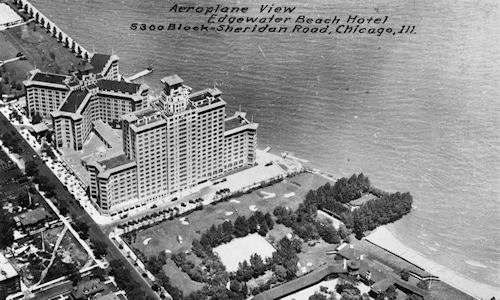
Cochran built a lot of homes and also the famous Edgewater Beach Hotel.  There is a building at Bryn Mawr and Sheridan that people call "The Pink Hotel" which I thought was the original hotel, but it's not.  The original hotel (at the same location) was demolished in 1971.  The current building is a condo/co-op.

Anyway, the most interesting thing about the Edgewater Beach Hotel is that when it was built in 1916 (with an expansion in the 1920's), it was, appropriately enough, right at the water's edge.  Look at this picture from the museum's collection.

Source:  Edgewater Historical Society
http://www.edgewaterhistory.org/ehs/local/edgewater-beach-hotel
When Lake Shore Drive was built in the 1930's, they brought in fill to move the lake several hundred yards to the east (to the right in the picture shown above).  (Can you even imagine how much fill was required for this?)  This north part of Lake Shore Drive was actually built more in the 1950's, from what I can tell.

Lake Shore Drive now is a major vehicle thoroughfare, which I can assure you is well traveled because I can see traffic 24/7 from my window.  It is also, apparently, a test lab for car horns.

The second best thing about Lake Shore Drive is the Lake Shore Trail, which is an 18-mile pedestrian/bike path that starts from Hollywood, where I live, and goes south for, well, 18 miles.  You can take it to Navy Pier (about seven miles south), the museum campus, and further south although I've never ridden past Navy Pier so I don't know exactly where it ends.  That will be another adventure sometime.

The best thing about Lake Shore Drive are all the beautiful beaches - free and open to the public - along the lakefront.


But I digress.

Edgewater is a wonderful neighborhood.  Part of that wonderfulness is the fact that it is very diverse and yet everyone seems to get along.  This store, which is on Clark Street, sort of symbolizes Edgewater to me.


You've got the GLBT rainbow colors, the name "Gordono's" and a sign saying it's a Jewish deli.  Of course, this one store doesn't take into account all of the people who make up Edgewater - immigrants from Central Europe and Africa, old people, young people and families, people of all races and religious backgrounds - but it sort of illustrates my point.  My friend Beth says that Edgewater is the first neighborhood everyone lives in when they move to Chicago.  On the street in Edgewater you hear so many languages, see gay and lesbian couples holding hands, and pass by little old men as well as young parents pushing strollers.  And dogs.  Good Lord, there are a lot of dogs in Edgewater.  But, like the people, the dogs are all well behaved and generally friendly.

Back to the Edgewater Historical Society and the Living Treasures exhibit.  I'm new to the city, of course, so I've never heard of any of the 25 people.  But while I was there, a couple who have lived in the neighborhood for many years came in based on the Tribune article (they said to the nice lady at the front desk) and mentioned that they knew a couple of the people who were listed in the article.

The individuals honored included a few who had positions of formal leadership - an alderman, a rabbi, a school principal - but most of them were just regular residents.  All of them went above and beyond their job descriptions in doing something to make Edgewater special.

For instance, take Sheli Lulkin.  She was concerned about Lake Michigan's rising lake levels and worked to make sure that appropriate steps were taken to protect Sheridan Road properties - something near and dear to me, because that's where I live.  On my morning walks I had seen a large pile of rocks at the very north end of the beach, and had remembered it largely because I thought my sisters' and brother's kids would have a great time climbing on it.  But they had a picture of this same pile of rocks in the Sheli Lulkin exhibit, because the rocks are part of a lake stabilization project.  It was sort of cool to learn why those rocks were there, since I had felt an oddly personal connection to them.

The honorees reflect the diversity of Edgewater.  People who immigrated from Israel, Ethiopia, France, Germany, and the south side of Chicago were among the group.  They worked on just about every issue you can imagine:  crime prevention, environmental concerns, human service needs, equal protection and human rights, gardening and neighborhood beautification...the list goes on and on.  And I'm going to say here, because as I like to remind you this is my blog and I can say whatever I want, that it is so nice to live in a city where elected officials are honored for their work to make gay/lesbian/bisexual/transgendered people full citizens of the community, rather than being voted out of office for it.  Have I mentioned how much I love Chicago?

I think it's great that they are honoring people who are still around to accept the honor rather than waiting until they die, which is often what happens.  And this kind of exhibit is also a great way of showing that every person can make a difference if he or she chooses to do so. History is made up of people like Sheli Lulkin and my buddy Viggy.  It is us, not them.

The rest of the museum consists of some smaller exhibits about the area's history and development, political history (more on that in a minute), and a wall of fame (my words, not theirs) of people who are from Edgewater.

One learns from this exhibit that if it weren't for Edgewater there would have been effectively no popular fiction written in the 1970's other than Harlequin Romances, since both John Jakes and Sidney Sheldon are from the neighborhood.  Other notable Edgewaterians (I'm not sure what the actual noun would be, but don't you think there's sort of a ring to Edgewaterian?) include Clayton Moore (a.k.a. The Lone Ranger), cartoonist Herbert Block, athlete Fritz Pollard (who, along with Jesse Owens, was one of the medal-winning African-American athletes at the 1936 Berlin Olympics who embarrassed Hitler and his Nazi myth of Aryan Supremacy), and actress Lois Nettleton (whom I had never heard of by name, but recognized her immediately from her appearances on Seinfeld, among other things).

Photo credit:  Wikipedia
http://en.wikipedia.org/wiki/Lois_Nettleton
That is quite a list, and there were some others which I didn't include here.

Don't worry, I haven't forgotten the part about politics.

I recently read City of Scoundrels by Gary Krist, which is a very interesting history of "The 12 Days of Disaster That Gave Birth to Modern Chicago" as it is subtitled.  The book is about events during the summer of 1919 - starting with a blimp exploding over downtown, and including a protracted race riot, a crippling transit strike, and the murder of a little girl - that gave people the sense that the city was completely out of control.  The mayor during this time was "Big Bill" Thompson who was the last Republican mayor of Chicago and whom Wikipedia refers to as "among the most unethical mayors in American history."  That is actually quite a strong statement - the ethical part, not the Republican part.  Although maybe that, too.

Anyway, while not defending his ethics, Krist maintains that Thompson was an effective mayor during his first two terms - modern Chicago began with projects that started to be realized during his tenure.  Krist comments briefly about how the mayor who followed Thompson (and whom Thompson then followed four years later in what was not a successful administration) was a good-government type whose ethics were above reproach but who couldn't get anything done and whose aggressive enforcement of prohibition drove crime in the city to unprecedented heights as bootleggers and gangsters violently defended their territories.  (While I obviously would prefer my politicians honest, what I really want is for them to be able to accomplish great things for their communities and if I had to choose.....well, I'm living in Chicago so you get an idea of my priorities.)

Of course, Krist didn't have a "native son" relationship with William Dever, the interregnum mayor.  The Edgewater Historical Society does, as Dever was one of two mayors, both Democrats, from my neighborhood, so the museum's exhibit doesn't talk much about the results of Dever's service.  Enough that he was our guy.  Still, it was funny that I only know the names of two mayors before 1955 (when Mayor Daley the First took office),  and both of them are in the Edgewater exhibit.  (I learned a third name today, Martin Kennelly, who was the second Edgewater mayor and who preceded Mayor Daley from 1947-1955.)

The museum talks about the fact that the neighborhood is strongly Democrat, which is a nice change of pace for me, and includes in the politics exhibit a large picture of Edgewater's most famous daughter, none other than Hillary Clinton, who was born in Edgewater Hospital.  Take that, Barack Obama.  If she's elected President, they will probably have to put a new wing on the back of the building.

From the beach to the shops to the homes to the history, I love my neighborhood.  And the Edgewater Historical Society museum?  It's not quite the Museum of Science and Industry, but it's home.

Hey, did I just say "home?"

Monday, June 10, 2013

Blues, Books and I-Wish-Hipster-or-Yuppie-Began-With-a-B

As a number of my friends have pointed out, the first weekend in June was the first full weekend I've spent in Chicago, despite having moved here nearly six weeks ago.  But fear not, friends, I have been making up for lost time.  This past weekend I made it to three festivals in 24 hours, and hopefully that will stop the "have you spent a full weekend in Chicago yet?" line of questioning.

First up, on Friday, was the 30th Annual Chicago Blues Festival.  This is a free festival put on by the City of Chicago (and a ton of sponsors) in Grant Park downtown.  According to its website, it is the largest free blues festival on the planet, and it is the largest of Chicago's many music festivals.  Typically a half million people will attend over the course of three days.  It is massive.

What's funny however, is that it is unexpectedly hard to find.  When I got off the subway late Friday afternoon, I expected to see a large stream of people walking toward the festival; my plan was to follow them.  But there was no "them," or at least not enough of "them" that I could differentiate "them" from the rest of the sea of humanity leaving work on a Friday afternoon.  That's how big Chicago is:  an event that draws half a million people (granted, not all at once) is not easily distinguished from the rest of the city.  Anyway, I found it the same way I find anything else in downtown Chicago:  I wandered around a bit, completely without a clue, and eventually figured out where to go after exhausting all other directions.

Of course, with a music festival you start to hear the event before you see it, and that helped.  I came in from the back so my first encounter was with a small stage (they have five stages).  This was a smaller group, John Primer and the Real Deal Blues Band, and they ended their set with "Sweet Home Chicago."


Much to my surprise, I did not hear that song again.  Perhaps it's just too obvious.

The Blues Festival is one of those events where they make you buy annoying food and drink tickets at a separate booth from where you actually get the food and drink.  I dislike this for two reasons:  first of all because it makes you decide in advance how much you plan to eat and drink, and often you have to do it in the absence of knowing how much food and drink costs; and second, because it makes you have to stand in two lines rather than one.  I always feel like I'm in the Soviet Union, standing in the egg line, then standing in the bread line....you get my point.

But it was in the ticket line that I met Mr. Miller.  He and I started chatting, and then were joined by a young woman whose job as a bartender seemed well suited to her outgoing personality.  For instance, I know his name is Miller because she asked him what his favorite beer was and he answered, "Miller, because that's my name."  Mr. Miller is one of those older guys who looks younger than he is, despite, he told us, having had 19 children.  The bartender was somewhat flabbergasted at this and Mr. Miller said "yeah, it was a lot of fun," and I suggested that there were ways to still have a lot of fun without getting so many kids out of the deal, but luckily the conversation quickly turned into Mr. Miller telling us he was 71 years old.  "Get out," said my bartender friend, and I also expressed disbelief.  So Mr. Miller whips out his wallet to give us proof, at which time I observe that he has two Illinois driver's licenses.  (I guess that would be drivers' licenses, with the possessive after the plural.)  "I have several ID's because I travel a lot," said Mr. Miller.  I didn't even know where to begin with that one, so I let it drop, and then confirmed that the ID (the one I looked at, at least) did support his claim to be 71.

The interesting thing was that the name on the ID wasn't Miller.

But hey, it's Chicago.

Anyway, another interesting thing, I thought, about the Blues Festival were some of its sponsors.  There are the usual suspects (a beer brand, a soft drink brand, an IT brand, and a couple of miscellaneous large corporations) but the sponsor list also included the tourism departments of the States of Mississippi and Louisiana.  I guess those are bluesy places, along with the City of St. Louis, which had a booth as well, and they must figure that people who like the blues might go on vacation there.  Perhaps they're right - after all, I like the blues and I traveled through Mississippi and Louisiana.

After looking around, hearing a local band play for a while at one of the smaller stages, and getting my first Chicago hot dog since I moved here, I headed over to the main stage, where Earnest "Guitar" Roy was just getting started.

On stage I saw something I haven't seen since the last time I went to a women's music festival:  a sign language interpreter so that deaf people can follow along.


Like drive-through bank machines embossed with braille, I've always wondered how necessary this type of accomodation is.  Not that there's anything wrong with it.  And of course, with blues music the interpreter really only had to know about fifteen words so he had a relatively easy night.

"Guitar" Roy was great, and then the Blues Queen of New Orleans, Irma Thomas, took the stage.  She was even better.

Blues songs, like country music, seem to have more than their share of funny names.  "You Can Mess With My Husband but Please Don't Mess With My Man," is nearly as good a line as the country song, "If You Want to Keep the Beer Ice Cold Set It Next to My Ex-Wife's Heart."  The Blues Queen of New Orleans had the crowd on our feet with "Hip Shakin' Mama" and then I started to see something curious.  At first I just saw one person waving a handkerchief, but then it caught on.


And then,


Noticing this growing movement, Irma explained to the rest of us that this was called the Second Line, a New Orleans tradition.  The First Line in a parade are the main marchers.  The Second Line is made up of people who are just walking along with the music waving their handkerchiefs.

Now that we knew what was happening, everybody in the crowd joined in.  I didn't have a handkerchief but I had a white napkin left over from my hot dog dinner, so I pulled it out of my pocket and started waving it.  Good arm exercise.

Another thing I did that everyone else was doing was to snap a picture of the Blue Cross and Blue Shield of Illinois Building:


When in Rome, as they say...so I've become a minor Blackhawks hockey fan.  I don't have a jersey or anything, though.  At least not yet.  But they're pretty cool so who knows what could happen by next season?

The headliner Friday night was Bobby Rush and his Blues Band.  I'd been sitting down for a while at this point, and it was starting to get just dark enough that it made me realize that it would be a good time to check out the port-a-johns while I could still see.  So I took a little break and when I returned I just stood at the back of the amphitheater, along with a bunch of random people and an enthusiastic group of exhibitors wearing blue Intel jackets.  There were a fair number of uniformed police officers around, and I assumed there were at least a few in plain clothes, so I was a little surprised when the wind shifted slightly and I caught a quick but clear whiff of marijuana.  And then it was gone.

I was starting to wear down by this point so I listened to Bobby for a while and then decided to find the Red Line home.  On the way out I saw some other musicians playing.


I found the Monroe Red Line station, which as you know isn't on Monroe at all, and called it a night.  I had big plans for Saturday, after all.

Those plans began with hopping back on the Red Line Saturday morning to head back downtown.  This time when I got off at the Harrison Street station, which is actually on Polk and State, I went one block west rather than three blocks east, and found myself in the middle of the Printers Row LitFest. It is a free event, organized by the Chicago Tribune, that brings together authors and readers of all types.  Part of it is a street festival, although without music.


Lots of book vendors and exhibits by publishers, writers' groups, and so forth.  There was also a display by a yarn shop, which happens to be located in Printers Row, so I checked in with her about weaving classes which, along with bridge, is on my to-do list.  But I may delay my weaving career, because I'd rather use time this summer to figure out what I want to do about novelizing the Driveabout and you can't do everything at once.  LitFest inspired me.

Printers Row itself has a number of older buildings which are impressive.  One of the buildings had this plaque above its door.  It's kind of a high standard.


They have a ton of speakers and workshops at LitFest - all of them free, but many requiring advance tickets.  I had come across it just the day before (thanks to my $12 subscription to the Tribune) so it was too late for me to get into the workshops.  I did see the 90 Second Newbery Film Festival - where kids submit videos of a minute and a half that act out a Newbery Award winning book.  The auditorium was filled with librarians who had read every single book that was mentioned.  If you work with kids (elementary through high school), you might find this to be a fun project.  Just check out their website.

While I was wandering through the tents I heard a 20-year-old poet who participated in a program called Young Chicago Authors read some of her work.  It was very powerful and very good.  She also read some poems that other people had written but hers were the most evocative, I thought.  It's tempting - and I know this because I succumb to it all the time - to write about topics that are both political and personal by emphasizing the big picture.  I think they are more powerful (especially in poetry) when you focus more on a personal angle.  This young woman did that, and she was excellent.

I found a great hamburger place, if you're ever in the mood for such a thing when you're in Chicago, and then went to hear Boston Globe reporters Kevin Cullen and Shelley Murphy talk about Whitey Bulger.  Bulger is the mobster who was also an FBI informant for decades, during which time he allegedly killed a bunch of people that the FBI knew about.  (They made a Law & Order episode based on this story, if that sounds familiar.)  Then Bulger disappeared for more than a decade until a neighbor in Santa Monica recognized him on TV, and his trial is starting today.  It was interesting to hear the reporters (who have written a book) talk about Bulger and their experience covering him for over twenty years.  Plus they had great Boston accents.  Fortunately, everyone was very polite about the upcoming Hawks versus Bruins Stanley Cup battle, so there were no fisticuffs.

Thus ended my LitFest experience, so it was back to the Red Line to go a few stops north to the Old Town Neighborhood and the Wells Street Art Fair.

Remember Mr. Miller from the Blues Festival?  In another episode of Big City/Small World, I saw him as I was coming out of the Clark & Division L station (which is, curiously, located at Clark and Division Streets.)  Really.  At first I didn't believe it as he walked right past me but then I looked and realized yeah, this is Mr. Miller.  I wasn't sure what name he was using that day, however, and I didn't particularly want to start a conversation, so I didn't say anything.

The Wells Street Art Fair is a nice art festival.  It goes on for about five blocks, and is very popular.  I arrived about 2:30 and as the afternoon wore on, the event turned from art fair to huge street party.  I can't estimate crowds, but there had to be 10,000 people, nearly all of whom were carrying a large cup of beer.  The preferred dress of most of the 20-something guys seemed like something straight out of the 1980's - button down shirts (some short sleeved, some long), often madras or plaid but also solid blue or white, and Bermuda shorts.  Thank goodness none of the women had Big 80's Hair, or I would have thought I was traveling in time, and I didn't care much for the 80's.

Most of the exhibitors are what you'd expect, but they did have a large installation of a car with a giant snake-shaped balloon popping out of it.  My favorite part of it, however, is the sign.


I couldn't get the entire installation, but you can sort of get a sense of it.  The sign says "Please Don't Jump on the Art!"  It's not as good as the "people have died" sign, but I liked it.

Initially I'd planned to walk through just to check it out and see if I could find a spoon rest (I did), but then I saw that at 3:30 Sophie B. Hawkins was going to play, followed by the Smithereens.  These were not to be missed, so I hung around and enjoyed the shows.


Sophie B. was certainly getting into it.  Her version of Janis Joplin's "Cry Baby" seemed oddly post-millennial, or something, to me - she hit all the right notes and performed with a lot of energy, but there was something authentic missing, even when she went all the way to the floor.


Still, I'm not complaining about a free concert.

By the way, the woman in the black shirt in this picture is someone I'd met a couple of times in Fort Wayne.  Again, Big City/Small World.

The crowd got a little older for the Smithereens.  (I guess I was time traveling after all.)  It was funny to see a bunch of guys my age and older doing air guitar (to be clear:  in the crowd, not on the stage).  I was standing behind a guy who seems like the Smithereens Number One Fan, in addition to being a big Blackhawks fan.


Everywhere I've ever been - even in the south - I've heard the "don't like the weather, wait ten minutes" line as if it were something unique about their region.  Right, weather changes.  Everywhere.  But it is very true in Chicago, and I am still not used to bringing along a jacket everywhere I go.  By 6:30 the clouds seemed to be beating the sun and my t-shirt wasn't warm enough, so I decided to call it a full day and head back home to Edgewater, where I enjoyed some Indian food and was able to put on a sweatshirt.

Sunday was uneventful and although fun, not of particular bloggage interest until I was coming home, once again, on the Red Line (this time from visiting my friend Val in Lincoln Park).  I don't remember for sure where they got on - I think Belmont or Addison - but a group of six early 20's guys, all very clean cut and white, and all wearing white dress shirts and black pants, got on my car.  A couple of them had name tags and one had a red handkerchief tied cowboy-style around his neck.  They were a friendly group and offered me a homemade chocolate chip cookie from the plateful that one of them was carrying.  I initially declined, but eventually did have one - the guy with the plate was sitting right next to me and the cookies smelled delicious.  They tasted just as good.

Anyway, all these guys are Irish, and are visiting Chicago for a few days for a bachelor party for Fergus, a red-headed accountant from Cork.  None of them live in the United States, and both the bride and the wedding are in Ireland, so it was a little unclear to me what exactly they were doing other than clearly having a great time.  They were really nice boys and we talked about Ireland for a while.  As the train approached my stop at Bryn Mawr, I told Victor, the best man (and baker of the cookies) to make sure that he got Fergus back on that plane, and he seems like a very good friend because he said that yes, he was going to make sure of it.

Mr. Miller, the woman from Fort Wayne, the boys from Ireland - the randomness of it all is really fun.

Yes, I love Chicago.